
What Is Cooling Tower Fill
When people talk about cooling tower performance, many engineers focus on fans, motors, pumps, and water flow systems. However, one important component inside the cooling tower is often overlooked — the cooling tower fill.
Cooling tower fill is the internal heat transfer media installed between the water distribution system and the air inlet area. Its main purpose is to increase the contact area between air and water, allowing heat to transfer more effectively during the cooling process.
In simple words, the cooling tower fill creates more time and space for water and air to exchange heat. Without proper fill media, even a well-designed cooling tower may not achieve the expected cooling performance.
For engineers who are selecting materials, replacing old components, or improving cooling tower efficiency, understanding different types of cooling tower fill media is an important step.
How Cooling Tower Fill Works Inside a Cooling System
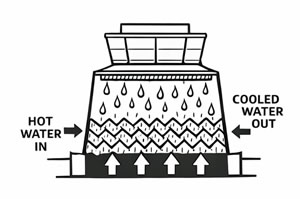
The working principle of cooling tower fill is relatively simple. Hot water enters the upper section of the cooling tower and flows downward through the fill material. At the same time, air moves upward or horizontally through the fill area depending on the tower design.
During this process, the surface of the fill allows water to spread into thin layers or small droplets. The increased surface area improves evaporation and heat exchange between water and air.
A properly selected cooling tower packing should provide a balance between several factors:
- Good water distribution
- Stable airflow performance
- Suitable pressure drop
- Resistance to operating conditions
- Easy maintenance and replacement
In practical projects, there is no single fill design that fits every cooling tower. The right choice depends on water quality, operating temperature, tower structure, and industry application.
Main Materials Used for Cooling Tower Fill
Most modern cooling tower fill media are made from plastic materials because plastic offers advantages such as corrosion resistance, lightweight structure, and easier installation compared with traditional materials.
PP Cooling Tower Fill Material
Polypropylene, commonly known as PP, is one of the widely used materials for modern cooling tower applications.
PP cooling tower fill is often selected for systems where good chemical resistance and stable performance are required.
The characteristics of PP material include:
- Good resistance to many chemicals
- Suitable for industrial cooling environments
- Good mechanical strength
- Suitable for higher temperature applications compared with some PVC materials
In industries such as chemical processing, power generation, and manufacturing plants, PP fill is commonly considered when operating conditions require stronger material performance.
PVC Cooling Tower Fill Material
PVC is another commonly used material for cooling tower fill production. Due to its processing characteristics and cost considerations, PVC fill has been widely applied in many HVAC and industrial cooling systems.
PVC cooling tower fill is frequently used in applications where temperature conditions and water quality are suitable for PVC material.
PVC fill media usually features:
- Good forming performance
- Lightweight structure
- Suitable for many standard cooling tower designs
- Convenient replacement during maintenance projects
When selecting between PP and PVC materials, engineers normally consider factors such as water temperature, chemical conditions, expected service environment, and project requirements rather than simply comparing materials.
Different Types of Cooling Tower Fill
According to the structure and heat transfer method, cooling tower fill can generally be divided into several categories. The most common types include film fill and splash fill.
Film Fill Cooling Tower
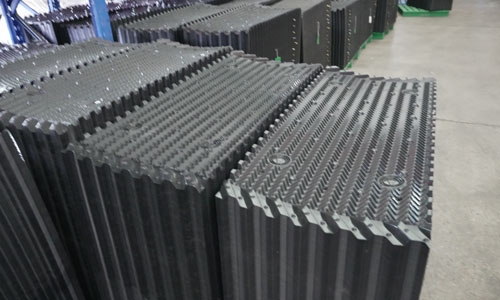
The film fill cooling tower design uses specially formed sheets to create a large surface area. Water flows over the surface of the sheets and forms a thin water film while air passes through the channels.
This design is widely used because it can provide efficient heat exchange in many applications where water quality is controlled.
Typical features of Film Fill include:
- Large contact surface between air and water
- Compact structure
- Suitable for counterflow and crossflow cooling tower designs
- Commonly used in HVAC and industrial cooling systems
For projects requiring replacement of existing crossflow tower components, Crossflow Film Fill is a commonly considered option.
Splash Fill
Unlike film fill, splash fill works by breaking falling water into smaller droplets. The repeated splashing process increases water and air contact.
Splash fill is often selected for applications where water contains more suspended solids or where blockage resistance is an important consideration.
Splash Grid Fill is one example of splash-type cooling tower fill media used in industrial cooling systems.
Compared with film fill, splash fill generally has a more open structure, which can be helpful in certain environments with higher levels of impurities in circulating water.
Common Applications of Cooling Tower Fill
Cooling tower fill is used in many industries where heat needs to be removed from circulating water systems. The selection of fill type usually depends on the specific working conditions.
HVAC Cooling Systems
Commercial buildings, hotels, shopping centers, and large facilities often use cooling towers as part of their air conditioning systems.
For these applications, engineers usually focus on stable operation, energy consumption, noise control, and easy maintenance.
Power Generation Industry
Power plants require continuous cooling performance because large amounts of heat are generated during operation.
Cooling tower fill used in these systems needs to consider long operating hours, water quality, and maintenance requirements.
Manufacturing Plants
Many manufacturing processes generate heat that must be removed through cooling systems. Industries such as steel production, chemical processing, food manufacturing, and electronics production commonly use cooling towers.
In these environments, the correct tower fill selection can influence system stability and maintenance frequency.
How to Choose the Right Cooling Tower Fill Media
Choosing cooling tower fill is not only about selecting a product size. Engineers normally evaluate several operating conditions before making a decision.
Consider Water Quality
Water quality is one of the first factors to check. Clean circulating water systems can often use high surface area film fill designs.
However, systems with higher levels of suspended particles may require designs with better resistance to blockage.
Consider Operating Temperature
Different plastic materials have different temperature resistance characteristics. Before selecting fill media, it is important to confirm the actual operating water temperature.
Consider Cooling Tower Design
Counterflow cooling towers and crossflow cooling towers have different internal airflow patterns. The fill structure should match the tower design to maintain proper air and water distribution.
Consider Maintenance Requirements
In real projects, easy maintenance is often as important as cooling performance. A fill design that is difficult to clean or replace may increase long-term operating challenges.
Common Problems Caused by Incorrect Cooling Fill Selection
Many cooling tower problems are related to improper fill selection or aging fill media.
- Reduced cooling efficiency
- Uneven water distribution
- Higher fan energy consumption
- Increased scaling or blockage risk
- Shorter maintenance intervals
When a cooling tower does not perform as expected, engineers usually check the complete system instead of replacing only one component. Water flow, airflow, nozzle condition, fan operation, and fill condition should all be reviewed together.
Cooling Tower Fill Replacement Tips
Replacing old fill media is a common maintenance project for many cooling tower systems.
Before replacement, it is recommended to check:
- Original fill dimensions
- Tower airflow direction
- Water distribution method
- Existing operating problems
- New material requirements
A suitable replacement can help restore the original cooling tower design performance and improve operating stability.
Final Thoughts on Cooling Tower Fill Selection
Cooling tower fill may look like a simple plastic component, but it plays an important role in the heat transfer process. The right choice depends on many practical factors, including material, structure, water quality, temperature, and tower design.
For engineers and cooling system operators, understanding different types of tower fill, cooling fill designs, and application requirements can help avoid unnecessary maintenance issues.
Whether selecting film fill, splash fill, PP material, or PVC material, the best solution is usually the one that matches the actual working environment of the cooling system.
2026-3-6
2025-12-13