
Cooling Tower Fill vs Energy Consumption: How Fill Design Impacts Operational Cost in Industrial Systems
In most industrial facilities, cooling tower fill is selected based on price and initial performance data. However, from an engineering and financial perspective, the long-term impact of fill design on energy consumption is often significantly underestimated.
Cooling towers operate continuously in many industries, including power generation, petrochemical processing, HVAC, and manufacturing. Even small inefficiencies in heat transfer or airflow resistance can lead to substantial increases in operational cost over time.
This article explains how cooling tower fill design influences energy consumption, how to evaluate this impact quantitatively, and how to make engineering decisions that reduce long-term cost rather than just initial investment.
1. Where Energy Is Consumed in a Cooling Tower System
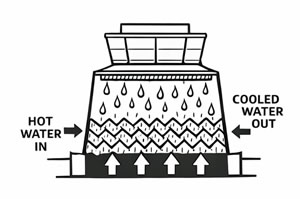
Cooling towers do not directly consume thermal energy. Instead, energy is consumed by mechanical systems required to maintain airflow and water circulation:
- Fan motor power (air movement)
- Pump energy (water circulation)
- Downstream system load (chillers, compressors)
Cooling tower fill media affects all three of these indirectly through its influence on heat transfer efficiency and airflow resistance.
2. Relationship Between Fill Efficiency and Fan Energy
2.1 Airflow Resistance (Static Pressure)
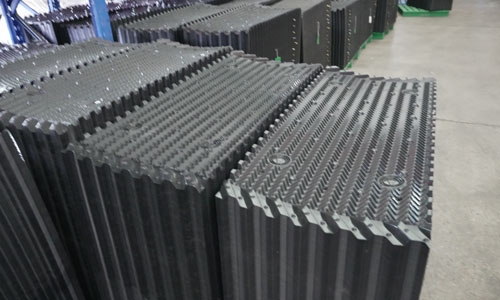
High-efficiency film fill structures increase surface area but also increase resistance to airflow. This results in higher static pressure inside the tower.
When airflow resistance increases:
- Fan motors must operate at higher load
- Energy consumption increases non-linearly
- Mechanical wear on fans increases
For example, replacing a 27mm spacing fill with a 12mm high-density film fill may improve heat transfer but increase pressure drop significantly if the system is not designed for it.
2.2 Fan Power Sensitivity
Fan energy consumption follows a cubic relationship with airflow changes. This means:
- 10** increase in airflow demand → up to 30** increase in power
Improper cooling tower fill selection can unintentionally increase fan energy cost over the entire lifecycle.
3. Cooling Efficiency and Downstream Energy Impact
Cooling tower performance directly affects downstream equipment such as chillers and compressors.
If cooling tower fill efficiency decreases:
- Cold water temperature rises
- Chiller load increases
- Compressor power consumption increases
In HVAC systems, even a 1°C increase in condenser water temperature can increase chiller energy consumption by 2–4**.
4. Degradation of Cooling Tower Fill and Hidden Energy Cost
Over time, cooling tower fill experiences degradation due to:
- Scaling and fouling
- Biological growth
- Thermal deformation
As channels become partially blocked:
- Airflow becomes uneven
- Pressure drop increases
- Heat transfer efficiency decreases
Systems using PVC cooling tower fill in high TDS environments may experience faster efficiency decline compared to more open structures.
5. Film Fill vs Splash Fill: Energy Perspective
5.1 Film Fill
- Higher initial efficiency
- Lower tower size requirement
- Higher sensitivity to fouling
Film fill cooling tower systems are ideal for clean water conditions where maintenance is controlled.
5.2 Splash Fill
- Lower initial efficiency
- More stable performance over time
- Lower airflow resistance variation
In dirty water conditions, splash fill may provide better long-term energy stability despite lower theoretical efficiency.
6. Lifecycle Energy Cost Modeling
To evaluate cooling tower fill economically, engineers should consider:
- Initial efficiency
- Efficiency degradation rate
- Fan power increase over time
- Maintenance frequency
For example:
- High-efficiency fill → lower initial energy cost but faster degradation
- Robust fill → slightly lower efficiency but stable long-term performance
The optimal solution depends on operating conditions, not catalogue data.
7. Engineering Strategy for Energy Optimization
- Match fill structure with water quality
- Ensure fan capacity matches pressure drop
- Monitor approach temperature trends
- Plan periodic cleaning and inspection
Cooling tower fill is not just a passive component — it actively influences system energy consumption throughout its lifecycle.
8. Common Engineering Mistakes
- Selecting high-density fill without airflow verification
- Ignoring long-term fouling impact
- Focusing only on initial efficiency rating
- Underestimating energy cost over 5–10 years
Conclusion: Cooling Tower Fill Is an Energy Decision
Cooling tower fill selection should be treated as an energy optimization decision, not just a material purchase.
Proper selection reduces fan energy consumption, improves cooling efficiency, and lowers overall operational cost across industrial systems worldwide.
Looking to reduce cooling system energy cost?
Share your tower type, operating temperature, and energy data. Our engineers can help evaluate how cooling tower fill design impacts your system efficiency.
2026-3-6
2025-12-13