
Cooling Tower Fill Engineering Guide for Industrial Cooling Systems
Introduction Cooling Tower Efficiency Loss Often Misdiagnosed
In many industrial cooling plants, performance decline is frequently attributed to mechanical equipment such as pumps or fans.However, field inspections across Southeast Asia and Middle East facilities show that the actual degradation often originates inside the heat exchange packing section.
A gradual reduction in heat transfer efficiency is usually caused by internal blockage, uneven water distribution, or structural collapse of Cooling tower fill.These issues often develop silently over months before operators notice temperature deviation.
In refinery cooling systems and industrial HVAC networks, we have recorded efficiency drops of 15–30** caused solely by degraded fill performance.
Once the internal media loses hydraulic stability, no external system adjustment can fully restore thermal efficiency without intervention in the fill section.
What Is Cooling Tower Fill Industrial Function Overview
Cooling tower fill is the engineered internal structure responsible for maximizing heat exchange between water and air streams.It is also known as cooling fill or tower fill in industrial documentation.
Its primary engineering role is to increase contact surface, regulate flow velocity, and enhance evaporation-driven heat rejection.
Modern systems rely on structured cooling tower fill media instead of random packing to ensure predictable hydraulic behavior.
Industry standards such as ASHRAE and CTI emphasize that fill geometry directly influences thermal performance stability and energy consumption levels.
Types of Cooling Tower Fill in Engineering Applications
Film Fill High Efficiency Surface Contact System
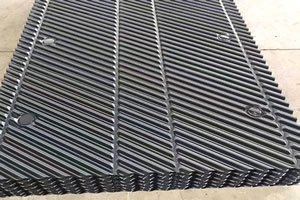
Film fill operates by spreading water into thin layers across engineered surfaces to maximize heat transfer.It is commonly used in systems where water quality is stable and suspended solids are minimal.
In high-performance HVAC installations, film fill cooling tower systems are preferred due to their high thermal efficiency characteristics.
Advanced corrugated fill designs are often used to improve turbulence and increase surface wetting consistency.
Splash Fill Impact Based Cooling Mechanism
Splash fill relies on repeated water breakup through mechanical impact rather than continuous film formation.This makes it suitable for environments with high particulate contamination.
Industrial facilities such as mining operations and steel production plants often adopt splash fill cooling tower configurations due to their fouling resistance.
Although efficiency is slightly lower compared to film systems, operational reliability is significantly higher under harsh conditions.
Corrugated Fill Structured Flow Optimization Design
Corrugated fill improves uniform distribution of water and reduces channeling effects within the tower.
Compared with older generation packing systems, modern structured designs offer better predictability in Cooling tower fill performance.
It also reduces localized dry zones that can cause uneven thermal behavior.
Cooling Tower Fill Materials Engineering Selection
PVC Cooling Tower Fill Standard Industrial Option
PVC cooling tower fill is widely used in standard cooling applications due to its balance of cost, durability, and thermal stability.
It performs effectively in moderate temperature environments typically below 60°C.
In retrofit applications, upgrading to PVC Cooling Tower Fill often restores 10–20** of lost thermal performance depending on fouling severity.
However, long-term exposure to high UV radiation and aggressive chemicals may reduce structural lifespan.
PP Cooling Tower Fill High Resistance Engineering Material
PP cooling tower fill is designed for environments requiring high chemical resistance and thermal stability.
It offers improved mechanical strength and reduced deformation risk under thermal cycling conditions.
In wastewater treatment plants and chemical processing facilities, PP is commonly selected for long lifecycle Cooling tower fill replacement strategies.
Performance and Efficiency Engineering Evaluation
Thermal performance is directly influenced by the internal hydraulic behavior of the Cooling tower fill system.
Key performance parameters include:
- Water film distribution consistency
- Airflow resistance balance
- Contact time optimization
- Fouling accumulation rate
Field measurements indicate that optimized fill systems can improve cooling performance by approximately 15–30** compared to degraded installations.
In tropical climates, properly designed systems reduce fluctuation in outlet temperature and stabilize long-term operational efficiency.
How to Select Cooling Tower Fill Engineering Procurement Approach
Selection of Cooling tower fill must be based on operating conditions rather than initial material cost alone.
- Water contamination level: determines film or splash selection
- Thermal load range: affects polymer selection strategy
- System configuration: crossflow or counterflow layout
- Maintenance capability: determines cleaning interval feasibility
Engineering procurement decisions should prioritize lifecycle performance rather than upfront investment cost.
In unstable water systems, cooling tower fill for dirty water configurations significantly improve operational reliability.
Common Failure Mechanisms in Cooling Tower Fill Systems
Hydraulic Blockage and Flow Restriction
Blockage is a frequent failure mode in Cooling tower fill systems caused by sediment accumulation and biological growth.
This results in uneven airflow distribution and increased energy consumption.
Mineral Deposition and Surface Scaling
Scaling occurs when dissolved minerals crystallize on fill surfaces under thermal conditions.
This significantly reduces heat transfer efficiency and increases cooling demand.
Polymer Aging and Structural Degradation
Exposure to heat, UV radiation, and chemical agents leads to polymer aging over time.
This results in brittleness and partial structural failure of tower fill systems in long-term operation.
Cooling Tower Fill Maintenance Engineering Strategy
- Regular inspection of Cooling tower fill every 6–12 months
- Preventive chemical cleaning for scaling control
- Continuous monitoring of water quality parameters
- Partial replacement of damaged modules instead of full overhaul
Field data shows that proper maintenance practices can extend operational lifespan by 35–60**.
Real Engineering Case Applications Field Experience
Southeast Asia Industrial Water Cooling Facility
A large manufacturing plant in Thailand experienced performance instability due to biofouling accumulation in cooling circuits.
After implementing structured PP cooling tower fill, thermal stability improved by approximately 17** under variable load conditions.
Middle East High Temperature Cooling Operation
A desert-based industrial plant faced repeated deformation issues under extreme heat conditions.
After redesigning internal packing using reinforced Cooling tower fill, system stability improved significantly during peak summer operation.
Korea Industrial Process Cooling System
High mineral content water caused continuous scaling and efficiency decline.
Implementation of optimized Crossflow Film Fill improved heat transfer consistency and reduced maintenance frequency.
Comparison Table Cooling Tower Fill Engineering Options
| Type | Thermal Efficiency | Fouling Resistance | Application Environment |
|---|---|---|---|
| Film Fill | High | Low | Stable clean water systems |
| Corrugated Fill | Very High | Medium | General industrial cooling |
| Splash Fill | Medium | High | High contamination environments |
Conclusion Cooling Tower Fill Engineering Importance
In industrial cooling systems, Cooling tower fill is a critical thermal component that determines overall system efficiency and stability.
Engineering data confirms that correct selection and maintenance can improve performance by 15–30** while reducing long-term operational instability.
For industrial operators in Southeast Asia, Middle East, Japan, and Korea, successful system design depends on matching water conditions, temperature requirements, and maintenance strategy with appropriate fill structure.
Proper engineering decisions significantly reduce energy consumption and extend system lifecycle in demanding industrial environments.
FAQ Cooling Tower Fill Engineering Questions
What is the typical service life of cooling tower fill
Service life generally ranges from 3 to 8 years depending on operating conditions and water quality.
What leads to cooling tower fill blockage
Blockage is mainly caused by suspended solids, microbial growth, and insufficient water treatment.
Which material is better PVC or PP
PVC is suitable for standard applications while PP is preferred for high temperature and corrosive environments.
How much efficiency improvement is possible
System upgrades can improve efficiency by approximately 15–30** depending on baseline condition.
What fill type is best for polluted water systems
Splash-based designs are recommended for high fouling industrial environments.
About the Author
Senior Cooling Tower Engineer with more than 10 years of industrial experience in thermal system optimization, cooling tower design, and field troubleshooting across Southeast Asia, Middle East, Japan, and Korea.Specialized in performance diagnostics and lifecycle improvement of industrial cooling tower fill systems under real operating conditions.
2026-3-12
2026-1-30
Cooling Tower Fill Maintenance...
2025-12-22
Comparison Guide: Counterflow ...
2025-12-10