
Cooling Tower Fill Selection Guide for Industrial Engineers: A Technical Decision Framework
Introduction: Why Cooling Tower Fill Selection Is Often Oversimplified
In many cooling tower projects, Cooling Tower Fill is treated as a standard component. Engineers often focus on pump capacity, fan motor size, and heat load calculations, while fill selection is decided based on price or past habit.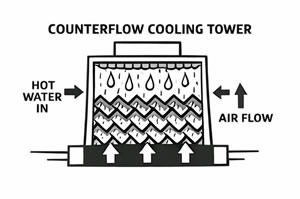
This approach works only in stable HVAC environments. In industrial systems, incorrect Cooling Tower Fill selection can result in:
- Reduced thermal efficiency
- Frequent maintenance shutdowns
- High fan energy consumption
- Premature fill replacement
- Long-term operational instability
Cooling Tower Fill is the primary heat exchange surface inside the tower. It determines the effective contact area between water and air. Once the fill performance declines, overall cooling capacity drops even if mechanical components remain functional.
This technical guide provides a structured engineering framework for selecting Cooling Tower Fill in industrial applications worldwide.
Step 1: Define the Real Operating Temperature Range
Most design documents list nominal water temperature. However, for Cooling Tower Fill selection, the critical factor is maximum continuous temperature rather than occasional peak temperature.
Questions engineers should confirm:
- What is the maximum continuous inlet water temperature?
- How many hours per day does the system operate above 45°C?
- Is there seasonal variation?
Material Temperature Limits
PVC cooling tower fill typically operates safely under continuous temperatures up to approximately 50–55°C. Beyond this range, long-term structural softening may occur.
PP Cooling Tower Fill offers higher thermal stability and is more suitable for systems where inlet water temperature frequently exceeds 55°C.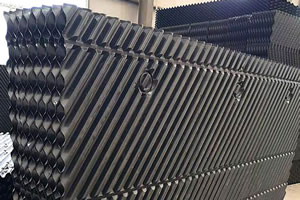
In global industrial markets such as the Middle East, Southeast Asia, Africa, and South America, high ambient temperature combined with industrial process heat often pushes systems toward higher operating ranges.
Step 2: Evaluate Water Quality Parameters
Cooling Tower Media selection must match water chemistry. The following parameters are critical:
- Total dissolved solids (TDS)
- Calcium hardness
- Silica content
- Suspended solids
- Oil contamination risk
- Biological growth potential
Film Fill Cooling Tower Applications
Film Fill Cooling Tower designs provide high thermal efficiency due to large wetted surface area. They are ideal for:
- Clean or treated water systems
- HVAC commercial towers
- Data center cooling systems
- Pharmaceutical manufacturing plants
However, narrow channel spacing increases clogging risk in high-scaling environments.
Splash Grid Fill Applications
Splash Grid Fill is more tolerant of dirty or high-solid water conditions. It is commonly used in:
- Steel plants
- Mining operations
- Chemical process cooling
- Wastewater cooling towers
The open structure reduces clogging and simplifies cleaning.
Step 3: Consider Airflow Design and Pressure Drop
Cooling Tower Fill selection cannot be separated from airflow engineering. Increasing surface area often increases pressure drop.
Key engineering considerations include:
- Fan capacity and motor margin
- Static pressure tolerance
- Air distribution uniformity
- Louver configuration
If fill structure creates excessive resistance, fan motors may operate at higher load, increasing energy consumption and mechanical wear.
Step 4: Structural Stability and Support Design
Industrial cooling towers are exposed to vibration, thermal expansion, and mechanical load.
Engineers should confirm:
- Support beam spacing
- Module size compatibility
- Sheet thickness and rigidity
- UV stabilization level
Improper support can cause sagging of Film Fill blocks, reducing airflow channels and accelerating failure.
Step 5: Lifecycle Cost Analysis Instead of Initial Price
Industrial decision-making must evaluate Cooling Tower Fill based on total lifecycle cost rather than purchase price alone.
Lifecycle factors include:
- Replacement interval
- Maintenance downtime
- Energy consumption impact
- Cleaning frequency
In many industrial cases, higher-grade Cooling Tower Fill reduces overall operating cost over 10-year system life.
Global Industrial Application Comparison: Cooling Tower Fill Requirements by Industry
Cooling Tower Fill selection varies significantly depending on industry type. A universal solution does not exist. Engineers must evaluate operating conditions specific to their sector.
Power Generation Plants
Power plants typically operate large-scale cooling towers with continuous load. Key characteristics include:
- Stable but high thermal load
- Large water flow rate
- Long operating hours (often 24/7)
- Strict efficiency requirements
In these systems, Film Fill Cooling Tower configurations are commonly used due to high heat transfer efficiency. However, material selection must consider continuous water temperature and chemical dosing levels.
For high-temperature condenser discharge systems, PP Cooling Tower Fill may offer longer structural stability compared to PVC cooling tower fill.
Oil & Gas and Petrochemical Facilities
Petrochemical cooling systems often face:
- Elevated water temperatures
- Hydrocarbon contamination risk
- Chemical exposure
- High ambient temperature (Middle East, Africa)
Under such conditions, Cooling Tower Media must resist thermal stress and chemical degradation. In many refineries, splash-type structures are preferred for better fouling resistance.
Steel and Metallurgical Industry
Steel mills present one of the harshest cooling environments:
- High suspended solids
- Dust contamination
- Scale particles
- Fluctuating temperature loads
In these cases, Splash Grid Fill is often more reliable than fine-pitch Film Fill. Although theoretical heat transfer efficiency may be lower, long-term operational stability is significantly higher.
Commercial HVAC and Data Centers
HVAC cooling towers generally operate with treated water and moderate temperatures. Here, maximizing thermal efficiency is often the priority.
Film Fill Cooling Tower designs dominate this sector due to high surface area and lower footprint requirements.
Common Cooling Tower Fill Selection Mistakes
Mistake 1: Selecting Based on Price Only
Low-cost Cooling Tower Fill may reduce upfront expense but shorten service life under demanding industrial conditions.
Mistake 2: Ignoring Continuous Temperature Exposure
Design peak temperature is not the same as real operating temperature. Continuous exposure above material tolerance accelerates deformation.
Mistake 3: Over-Specifying for Clean Systems
In clean HVAC systems, over-thick or industrial-grade fill may increase pressure drop unnecessarily.
Mistake 4: Underestimating Water Quality Impact
Water chemistry is often treated as a separate discipline, but it directly determines Cooling Tower Fill lifespan.
Engineering Decision Matrix for Cooling Tower Fill Selection
The following simplified matrix can assist engineers in preliminary selection:
- Water Temperature < 45°C + Clean Water: PVC Film Fill
- Water Temperature 45–55°C + Moderate Scaling: Higher-grade PVC or reinforced Film Fill
- Water Temperature > 55°C Continuous: PP Cooling Tower Fill
- High Suspended Solids: Splash Grid Fill
- Oil or Chemical Contamination Risk: PP or chemically resistant material
This framework should always be verified with detailed operating data.
Risk Assessment Model for Long-Term Stability
Cooling Tower Fill failure risk can be estimated by analyzing five dimensions:
- Thermal risk (continuous high temperature)
- Chemical risk (water treatment intensity)
- Mechanical risk (support structure and vibration)
- Environmental risk (UV exposure and dust)
- Maintenance discipline (inspection frequency)
When multiple high-risk factors combine, selecting higher-grade Cooling Tower Media significantly reduces long-term operational uncertainty.
Why Cooling Tower Fill Determines System Efficiency Over Time
Mechanical equipment such as fans and pumps can be repaired or replaced individually. However, Cooling Tower Fill degradation often affects the entire tower performance uniformly.
As fill efficiency declines:
- Approach temperature increases
- Fan load increases
- Water evaporation rate changes
- Overall plant energy efficiency decreases
In large industrial installations, even 1–2°C efficiency loss can translate into significant annual energy cost increases.
Final Engineering Perspective
Cooling Tower Fill selection is not a minor procurement decision. It is a long-term operational strategy decision.
Industrial engineers should treat fill selection with the same analytical rigor applied to heat exchangers, pumps, and fan systems.
- PVC Cooling Tower Fill
- PP Cooling Tower Fill
- Splash Grid Fill
- Counterflow Film Fill
Looking for a technical evaluation of your cooling tower system?
Share your industry type, operating temperature, and water analysis data. Our engineering team can recommend a Cooling Tower Fill configuration optimized for long-term performance and global industrial standards.
Contact Us
2026-4-12
2025-12-17
Crossflow Film Fill, Cooling T...
2025-12-9
Guide to Cooling Tower Fill Sp...
2025-11-29