
What Are the Types of Fills Used in Cooling Tower?
One of the most common mistakes I see in cooling tower projects is selecting the fill based only on price, without fully understanding the different types of cooling tower fill and how they perform under real operating conditions.
In reality, fill type selection should be based on water quality, cooling tower design, operating temperature, and maintenance capability. Especially in Southeast Asia, where water conditions and climate vary widely, the wrong fill type can lead to serious performance loss.
Main Types of Cooling Tower Fill
Film Fill
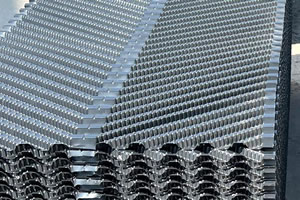
Film Fill is the most widely used cooling tower fill type today. It works by spreading water into thin films over corrugated sheets, maximizing the contact area between water and air.
This type of Cooling Tower Media is known for its high thermal efficiency and compact design.
Typical Film Fill Structure
- Corrugated PVC or PP sheets
- Optimized flute angles
- Controlled sheet spacing
Advantages of Film Fill
- Very high heat transfer efficiency
- Lower airflow requirement
- Compact cooling tower design
Limitations of Film Fill
- Sensitive to dirty water
- Requires proper water treatment
- Higher risk of fouling if neglected
Splash Fill
Splash Fill works on a completely different principle. Instead of forming water films, it breaks water into droplets by repeatedly splashing it over grids or bars.
Although splash fill generally has lower thermal efficiency than film fill, it offers excellent resistance to fouling and clogging.
Advantages of Splash Fill
- Handles poor water quality well
- Minimal clogging risk
- Easy inspection and cleaning
Typical Applications
- Industrial cooling with suspended solids
- Cooling towers using recycled water
- Older cooling tower retrofits
Cooling Tower Fill Type vs Tower Design
Counterflow Cooling Towers
Counterflow towers usually operate with higher air velocity and water loading. For these systems, high-efficiency Film Fill Cooling Tower designs are commonly used.
Material selection becomes critical to prevent deformation under continuous thermal and mechanical stress.
Crossflow Cooling Towers
Crossflow towers rely on gravity water distribution. The fill type must allow even airflow while maintaining consistent water coverage.
Crossflow film fill designs often feature larger flute spacing to reduce airflow resistance.
Efficiency Comparison Between Fill Types
| Fill Type | Thermal Efficiency | Water Quality Tolerance | Maintenance Demand |
|---|---|---|---|
| Film Fill | High | Medium | Medium |
| Splash Fill | Medium | High | Low |
Choosing the Right Fill Type: Practical Advice
From field experience, there is no universal “best” fill type. The correct decision depends on balancing efficiency and reliability.
- Good water quality → Film Fill
- Poor water quality → Splash Fill
- High efficiency requirement → Film Fill
- Low maintenance priority → Splash Fill
Related Cooling Tower Components
Summary
Understanding different cooling tower fill types helps you avoid costly mistakes. Film fill offers high efficiency, while splash fill provides durability under challenging water conditions.
Need Help Selecting the Right Fill Type?
If you are unsure which cooling tower fill type fits your project, send us your drawings or operating conditions for professional guidance.
2026-4-12
2025-12-17
Crossflow Film Fill, Cooling T...
2025-12-9
Guide to Cooling Tower Fill Sp...
2025-11-29