
Introduction Water Distribution Determines Cooling Efficiency
In industrial cooling towers, stable performance depends not only on airflow but also on how evenly water is distributed inside the system.Uneven water flow leads to dry spots, reduced contact area, and inefficient heat exchange.
At the core of this process is Cooling tower fill, which directly controls how water spreads and interacts with air.
A properly selected fill structure ensures uniform distribution, while an unsuitable design can create channeling, bypass flow, and performance loss.
What Role Cooling Tower Fill Plays in Water Distribution
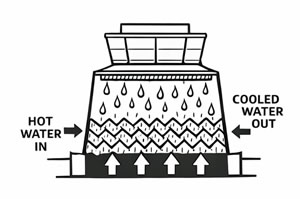
Cooling tower fill is designed to break incoming water into smaller streams, films, or droplets.
This process increases surface area and ensures that water is evenly spread across the entire fill section.
The performance of cooling tower fill media depends on its ability to maintain uniform distribution under different flow rates.
If water is not evenly distributed, some areas become overloaded while others remain underutilized.
Common Water Distribution Issues in Cooling Towers
Channeling Effect
Channeling occurs when water flows through specific paths instead of spreading evenly.
This reduces the effective working area of cooling tower fill.
It is often caused by improper fill design or installation misalignment.
Dry Spots Formation
Dry spots appear when certain areas of the fill do not receive sufficient water.
This results in reduced heat exchange efficiency and uneven cooling performance.
Water Bypass Flow
Bypass flow happens when water moves too quickly through the fill without proper contact with air.
This limits the effectiveness of the cooling tower fill structure.
Types of Cooling Tower Fill and Water Distribution Behavior
Film Fill Uniform Distribution with High Efficiency
Film structures spread water into thin layers across the surface.
A film fill cooling tower provides excellent distribution when water quality is good.
However, blockage can disrupt flow patterns and reduce uniformity.
Splash Fill Flexible Distribution in Variable Conditions
Splash structures rely on repeated impact to redistribute water.
A splash fill cooling tower handles uneven inflow conditions better and maintains stable distribution.
This makes it suitable for systems with fluctuating water quality.
Corrugated Fill Controlled Flow Path Design
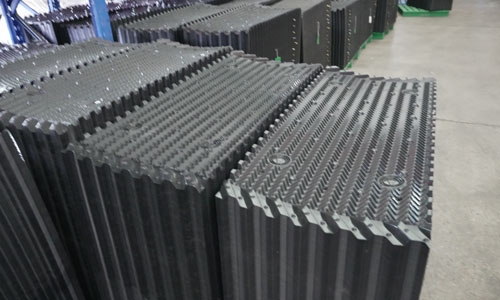
Corrugated structures guide water along predefined channels.
This improves distribution consistency while maintaining good airflow balance.
Corrugated fill is widely used in industrial systems for its stable performance.
How Fill Geometry Influences Water Spread
The geometry of cooling tower fill directly determines how water behaves inside the tower.
- Sheet spacing affects flow rate and distribution uniformity
- Surface texture influences water adhesion and film formation
- Angle design controls flow direction and redistribution
A well-designed cooling tower fill design ensures that water is evenly spread without excessive accumulation or fast bypass.
Material Selection and Distribution Stability
PVC Cooling Tower Fill Standard Application
PVC cooling tower fill offers stable surface characteristics that support uniform water spread.
It performs well under normal operating conditions but may deform under higher temperatures.
PP Cooling Tower Fill Enhanced Stability
PP cooling tower fill maintains its structure better in high temperature environments.
This helps preserve consistent water distribution over time.
Installation Factors Affecting Water Distribution
Alignment and Leveling
Improper installation can lead to uneven water flow.
Ensuring correct alignment is essential for optimal cooling tower fill performance.
Support Structure Stability
Weak support structures can cause deformation or displacement.
This affects both water distribution and airflow paths.
Nozzle and Distribution System Matching
Water distribution systems must match the fill design.
Incorrect nozzle selection can result in uneven loading of the fill surface.
How to Optimize Cooling Tower Fill for Better Distribution
Improving water distribution requires careful selection and system design.
- Choose fill type based on water quality
- Ensure compatibility with distribution system
- Select appropriate material for operating conditions
- Maintain proper installation alignment
- Perform regular inspection and cleaning
Using industrial cooling tower fill designed for specific applications helps maintain stable performance.
Real Engineering Cases Water Distribution Optimization
Manufacturing Plant Uneven Cooling Issue
A factory experienced inconsistent cooling across different sections.
Inspection revealed uneven water distribution due to improper fill structure.After replacing with a more suitable design, performance stabilized.
High Temperature System Deformation Problem
A system operating at elevated temperatures showed irregular water flow.
The fill had partially deformed, affecting distribution patterns.After upgrading material, uniformity improved.
Contaminated Water Application
A facility handling dirty water faced frequent blockage and uneven distribution.
Switching to a more open structure improved flow consistency and reduced maintenance.
Comparison Table Water Distribution Characteristics
| Fill Type | Distribution Uniformity | Clogging Resistance | Best Use |
|---|---|---|---|
| Film Fill | Excellent | Lower | Clean water systems |
| Splash Fill | Good | High | Dirty water systems |
| Corrugated Fill | Very Good | Moderate | General industrial use |
Conclusion Uniform Water Distribution Improves Cooling Stability
Water distribution is a key factor in cooling tower performance.
Selecting the correct Cooling tower fill ensures even flow, efficient heat exchange, and stable operation.
A well-matched design reduces operational issues and improves long-term system reliability.
FAQ Cooling Tower Fill Water Distribution Questions
What causes uneven water distribution in cooling towers
Improper fill design, installation errors, and nozzle mismatch are common causes.
Which fill type provides best distribution
Film fill provides the most uniform distribution under clean conditions.
Can distribution improve without replacing fill
In some cases, adjusting nozzles or cleaning can help, but structural issues require replacement.
Does material affect water distribution
Yes. Material stability affects long-term distribution consistency.
Is corrugated fill suitable for most systems
Yes. It offers a good balance between distribution and durability.
About the Author
Senior Cooling Tower Engineer with extensive experience in industrial cooling systems, focusing on water distribution optimization and fill structure design.
2026-3-6
2025-12-13