
Introduction Airflow and Water Interaction Define Cooling Performance
In industrial cooling towers, performance is not only determined by fan capacity or water flow rate.The internal structure plays an equally important role in how efficiently heat is removed from the system.
At the center of this process is Cooling tower fill, which controls how water and air interact inside the tower.
A well-designed fill structure ensures that water spreads evenly while air flows with minimal resistance.When the balance between airflow and water distribution is disrupted, cooling efficiency declines and energy consumption increases.
Understanding how fill design affects airflow helps engineers optimize system performance and avoid unnecessary operational issues.
What Is Cooling Tower Fill Role in Airflow Management
Cooling tower fill is designed to create a large contact surface between water and air.
As water flows through the fill, it is distributed into thin layers or droplets depending on the structure.At the same time, air passes through the fill to absorb heat and moisture.
The effectiveness of cooling tower fill media depends on how well it maintains this interaction without creating excessive resistance to airflow.
If airflow is restricted, the cooling process slows down even if water distribution is sufficient.
Types of Cooling Tower Fill and Their Airflow Characteristics
Film Fill High Surface Area with Controlled Airflow
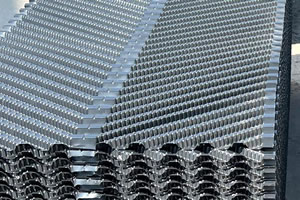
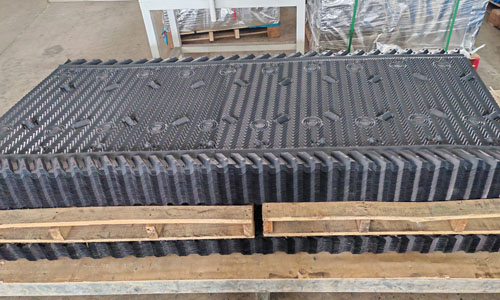
Film fill is designed to maximize heat transfer by forming continuous water films across its surface.
The film fill cooling tower structure provides high efficiency but requires controlled airflow conditions.
Because of its detailed internal channels, airflow resistance can increase if the structure becomes partially blocked.
This type is most effective in clean water systems where fouling is limited.
Splash Fill Open Structure with Lower Airflow Resistance
Splash fill uses a more open structure that allows air to pass through with less resistance.
Instead of forming films, it breaks water into droplets through repeated impact.
A splash fill cooling tower maintains stable airflow even when water contains impurities.
This makes it suitable for industrial environments with higher contamination levels.
Corrugated Fill Balanced Airflow and Heat Exchange
Corrugated fill uses shaped surfaces to guide both water and air movement.
This design creates turbulence, improving heat transfer while maintaining reasonable airflow resistance.
Many industrial cooling systems adopt corrugated fill because it offers a practical balance between efficiency and stability.
How Fill Structure Influences Heat Exchange Efficiency
The efficiency of heat exchange depends on three main factors:
- Surface area available for water-air contact
- Contact time between water and air
- Uniform distribution of both phases
A suitable cooling tower fill design increases surface area without significantly restricting airflow.
If airflow becomes too slow due to high resistance, the cooling effect decreases even if the surface area is large.
In contrast, if airflow is too fast without sufficient contact area, heat exchange becomes incomplete.
Balancing these factors is essential for maintaining stable cooling tower fill efficiency.
Material Selection Impact on Airflow Stability
PVC Cooling Tower Fill Standard Performance Option
PVC cooling tower fill is commonly used in many industrial systems due to its stable performance and cost efficiency.
It maintains structural consistency under normal operating temperatures, supporting stable airflow distribution.
However, under higher temperature conditions, deformation may occur, which can affect airflow paths.
PP Cooling Tower Fill For High Temperature Stability
PP cooling tower fill offers better resistance to heat and chemical exposure.
It maintains its structure more effectively in demanding environments, helping preserve airflow channels.
This makes it suitable for high temperature or chemically active systems.
Common Airflow Problems Caused by Improper Fill Selection
Airflow Blockage Due to Clogging
A cooling tower fill clogged condition reduces airflow significantly.
When internal channels are blocked by dirt or biological growth, air cannot pass evenly through the structure.
This leads to localized overheating and reduced cooling performance.
Excessive Air Resistance from Dense Structures
Selecting a structure with very high surface density can increase airflow resistance.
Fans may need to work harder to maintain airflow, increasing energy consumption.
In some cases, airflow becomes uneven across the tower.
Deformation Changing Airflow Path
Material deformation can alter the internal geometry of the fill.
This changes airflow distribution and reduces effective contact between water and air.
How to Optimize Cooling Tower Fill for Better Airflow
Improving airflow performance requires both proper design and correct selection.
- Match fill structure with water quality conditions
- Choose appropriate material for temperature range
- Avoid overly dense designs in high airflow systems
- Ensure proper installation alignment
- Maintain regular inspection and cleaning
For systems with higher contamination, selecting cooling tower fill for dirty water helps maintain airflow stability.
Optimization is not only about efficiency but also about maintaining long-term operational balance.
Real Engineering Experience Airflow Optimization Cases
Industrial Facility in Southeast Asia
A factory experienced increased energy consumption due to higher fan load.
Inspection showed that the existing fill structure created excessive airflow resistance.After replacing it with a more suitable design, airflow improved and energy consumption decreased.
Middle East High Temperature Application
A cooling tower operating under high temperature conditions showed uneven cooling performance.
The fill material had partially deformed, affecting airflow channels.After upgrading to a more stable material, airflow distribution improved significantly.
Contaminated Water Cooling System
A system handling industrial wastewater suffered from frequent airflow blockage.
After selecting a more open structure, airflow became more stable and maintenance frequency decreased.
Comparison Table Airflow Characteristics of Fill Types
| Fill Type | Airflow Resistance | Heat Transfer Efficiency | Best Application |
|---|---|---|---|
| Film Fill | Higher | Excellent | Clean water systems |
| Splash Fill | Lower | Good | Dirty water systems |
| Corrugated Fill | Moderate | Very Good | General industrial use |
Conclusion Proper Fill Design Ensures Stable Airflow and Efficient Cooling
The relationship between airflow and water distribution defines cooling tower performance.
Selecting the correct Cooling tower fill helps maintain this balance and ensures efficient heat exchange.
For industrial users in Southeast Asia, Middle East, Japan, and Korea, understanding airflow characteristics is essential for reliable system operation.
A well-matched fill design supports both efficiency and long-term stability.
FAQ Cooling Tower Fill Airflow Questions
Why does airflow decrease in cooling towers
Airflow reduction is often caused by clogging, scaling, or excessive resistance from unsuitable fill structures.
Does fill design affect fan energy consumption
Yes. Higher airflow resistance increases fan load and energy consumption.
Which fill type provides lowest airflow resistance
Splash fill generally provides lower resistance compared to film structures.
How can airflow be improved without replacing equipment
Improving fill selection and maintenance can significantly enhance airflow performance.
Is corrugated fill suitable for most applications
Yes. It provides a balance between airflow and heat transfer efficiency.
About the Author
Senior Cooling Tower Engineer with over 10 years of experience in cooling system optimization, airflow analysis, and industrial fill design.Focused on improving cooling efficiency and operational stability in complex industrial environments.
2026-4-12
2025-12-17
Crossflow Film Fill, Cooling T...
2025-12-9
Guide to Cooling Tower Fill Sp...
2025-11-29