
Introduction Cooling Tower Performance Depends on Internal Heat Exchange Quality
Many industrial operators focus on external cooling tower components when cooling performance decreases, such as fans, motors, or water pumps.However, the actual heat transfer limitation often develops inside the packing section where water and air exchange energy.
In factories, power plants, and process industries across Southeast Asia, Middle East, Japan, and Korea, reduced cooling capacity is frequently related to outdated, unsuitable, or contaminated Cooling tower fill.
When the internal structure cannot provide sufficient water spreading and air contact, the tower requires more energy to achieve the same cooling result.In some replacement projects, restoring the fill system improved cooling performance by more than 15**.
Choosing the correct fill type is therefore not only a maintenance decision but also an important part of industrial energy management.
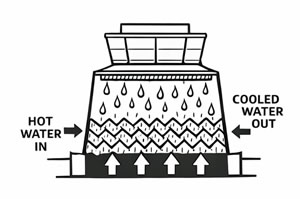
What Is Cooling Tower Fill Working Principle Explained
Cooling tower fill is the heat transfer medium installed inside a cooling tower to increase the contact area between circulating water and air.
The main purpose is to create better evaporation conditions by controlling water flow patterns and extending the interaction time between two phases.
Different structures provide different advantages. Some focus on maximum heat transfer efficiency, while others prioritize resistance against contamination and long operating periods.
Modern cooling tower fill media is engineered with specific surface patterns to balance thermal performance, airflow resistance, and maintenance requirements.
Types of Cooling Tower Fill Common Industrial Designs
Film Fill High Efficiency Cooling Solution
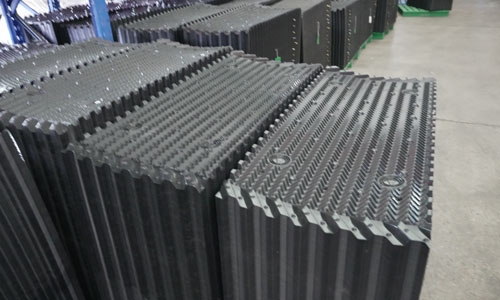
Film fill is designed to spread water into a thin continuous layer over a large surface area.This structure provides excellent heat transfer capability because more water surface is exposed to airflow.
The film fill cooling tower design is commonly selected for clean water systems where high efficiency is the main requirement.
Many modern film systems use corrugated fill surfaces to improve turbulence and maintain better water distribution.
Splash Fill Heavy Duty Industrial Solution
Splash fill breaks water into smaller droplets through repeated impact.This operating principle makes it suitable for applications where suspended particles or contaminants are present.
A splash fill cooling tower system is often used in steel plants, wastewater treatment facilities, and industrial processes with difficult water conditions.
Although its thermal efficiency may be lower than film structures, its durability under harsh conditions is often preferred.
Corrugated Fill Optimized Flow Structure
Corrugated fill uses specially designed sheet patterns to improve water movement and airflow balance.
This structure helps prevent uneven wetting and improves the consistency of heat transfer throughout the tower.
For many industrial cooling projects, corrugated designs provide a practical balance between efficiency and reliability.
Cooling Tower Fill Materials Selection Factors
PVC Cooling Tower Fill Economical Choice
PVC cooling tower fill is widely applied because it provides reliable thermal performance with reasonable cost.
It is suitable for general industrial cooling systems where temperature and chemical exposure remain within normal ranges.
Replacing old damaged packing with PVC Cooling Tower Fill can recover lost performance and improve operating stability.
PP Cooling Tower Fill High Performance Material
PP cooling tower fill provides better resistance against high temperature, chemical exposure, and mechanical stress.
It is commonly selected for demanding industrial environments where longer service life is required.
For chemical plants and harsh water applications, PP is often considered a reliable option for long-term Cooling tower fill replacement.
Performance and Efficiency Factors Affecting Cooling Results
The efficiency of a cooling tower depends on several interactions inside the fill section.A good design must achieve proper balance between heat transfer area, airflow resistance, and water distribution.
- Large effective surface area improves evaporation performance
- Uniform water distribution prevents inefficient dry areas
- Controlled airflow resistance reduces fan energy consumption
- Suitable material selection improves long-term stability
In actual industrial projects, improving cooling tower fill efficiency can reduce operating problems and help maintain stable process temperatures.
A properly selected cooling tower fill design can achieve noticeable performance improvement without changing the entire cooling tower structure.
How to Choose Cooling Tower Fill Based on Project Requirements
Engineers should evaluate actual operating conditions before selecting fill products.The best choice depends on water quality, temperature, system type, and maintenance capability.
- Clean circulating water: high efficiency film structures are suitable
- Heavy contamination: splash structures provide better reliability
- High temperature operation: PP material is recommended
- Limited maintenance access: durable designs reduce replacement frequency
For procurement teams, the lowest initial cost is not always the most economical solution.A correct selection can reduce future maintenance expenses and production interruptions.
Common Problems Affecting Cooling Tower Fill Performance
Clogging Problems
A cooling tower fill clogged condition usually results from dust, sediment, algae, or insufficient water treatment.
Blocked channels reduce airflow and limit effective heat exchange.
Scaling Problems
Mineral deposits gradually cover fill surfaces and reduce water spreading ability.
Scaling is especially common in regions with hard water conditions.
Aging Problems
Long-term exposure to sunlight, chemicals, and temperature changes can weaken plastic materials.
Aged fill may deform and lose the original design performance.
Maintenance Tips for Stable Cooling Tower Operation
- Check fill condition during regular shutdown inspections
- Control water quality parameters continuously
- Remove biological growth before serious blockage develops
- Plan replacement before efficiency loss affects production
Proper cooling tower fill maintenance helps extend service life and keeps thermal performance stable.
Real Engineering Experience Industrial Application Cases
Southeast Asia Manufacturing Cooling Project
A manufacturing facility in Thailand experienced unstable cooling during high production seasons.Inspection showed that old fill material had lost water distribution capability.
After upgrading the internal packing system, cooling efficiency improved by approximately 15** and temperature control became more stable.
Middle East High Temperature Industrial Project
A cooling system operating in a desert environment faced repeated performance reduction during summer months.
The original material could not maintain structural stability under continuous high temperature conditions.After changing to a more suitable material design, operation became more reliable.
Dirty Water Cooling System Project
An industrial wastewater cooling system suffered from frequent blockage caused by high suspended solids.
After changing to a more suitable cooling tower fill for dirty water solution, cleaning frequency was reduced and operating continuity improved.
Comparison Table Cooling Tower Fill Selection
| Fill Type | Main Advantage | Suitable Water Condition | Typical Application |
|---|---|---|---|
| Film Fill | High heat transfer efficiency | Clean treated water | HVAC systems power plants |
| Corrugated Fill | Balanced efficiency and airflow | General industrial water | Industrial cooling towers |
| Splash Fill | Strong fouling resistance | Dirty water systems | Steel wastewater industries |
| PP Fill | High temperature resistance | Chemical aggressive water | Process industries |
Conclusion Cooling Tower Fill Selection Creates Long Term Value
The performance of an industrial cooling tower depends greatly on the quality and suitability of its internal fill system.
Selecting the correct Cooling tower fill helps improve heat transfer, reduce maintenance problems, and maintain stable operation.
For industrial customers in Southeast Asia, Middle East, Japan, and Korea, engineers should consider operating environment, water quality, and lifecycle cost before making a final decision.
A well-designed fill system provides reliable cooling performance and supports continuous industrial production.
FAQ Cooling Tower Fill Questions
How often should cooling tower fill be replaced
Replacement depends on operating conditions, water quality, and maintenance level. Many industrial systems require replacement after several years of operation.
What causes cooling tower fill clogged issues
The main causes are suspended solids, algae growth, dust accumulation, and poor water treatment.
Is PP cooling tower fill better than PVC
PP provides stronger resistance for high temperature and chemical environments, while PVC remains suitable for standard applications.
Can replacement improve cooling tower efficiency
Yes. Replacing damaged or unsuitable fill can recover significant cooling performance depending on original conditions.
Which fill is suitable for dirty water applications
Splash fill is usually recommended because it provides better resistance against contamination.
About the Author
Senior Cooling Tower Engineer with more than 10 years of experience in industrial cooling system design, fill selection, replacement projects, and performance improvement.Experienced in solving cooling problems for industrial facilities across Southeast Asia, Middle East, Japan, and Korea with practical engineering solutions.
2026-3-6
2025-12-13