
Introduction Water Flow Uniformity Impacts Cooling Performance
In industrial cooling towers, system efficiency depends heavily on how evenly water is distributed across the internal structure.Poor distribution leads to uneven wetting, reduced heat transfer area, and unstable operation.
The key component controlling this process is Cooling tower fill, which governs how water spreads and interacts with airflow.
A well-designed fill structure promotes balanced water coverage, while an unsuitable configuration can result in flow imbalance and efficiency loss.
How Cooling Tower Fill Controls Water Distribution
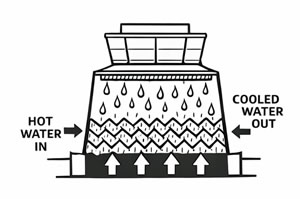
Cooling tower fill functions by breaking water into thin films or droplets.
This mechanism increases contact area and ensures consistent distribution throughout the fill zone.
The effectiveness of cooling tower fill media depends on its ability to maintain even flow under varying operating conditions.
Uneven distribution reduces system efficiency by limiting the active cooling surface.
Typical Water Distribution Problems in Cooling Towers
Flow Channel Formation
Flow channels develop when water concentrates along specific paths.
This reduces the working efficiency of cooling tower fill.
It is commonly caused by improper structural design or uneven installation.
Partial Dry Areas
Dry zones occur when certain regions receive insufficient water coverage.
These areas contribute little to heat exchange, reducing overall efficiency.
Rapid Water Passage
When water passes too quickly through the fill, proper air contact is not achieved.
This limits the effectiveness of the cooling tower fill system.
Cooling Tower Fill Types and Distribution Characteristics
Film Fill High Surface Coverage Distribution
Film structures create thin water layers across surfaces.
A film fill cooling tower provides uniform distribution under clean water conditions.
However, fouling may disrupt flow patterns over time.
Splash Fill Adaptive Distribution Performance
Splash designs redistribute water through repeated impact.
A splash fill cooling tower performs well under fluctuating water conditions.
It maintains stable distribution even with impurities present.
Corrugated Fill Guided Flow Distribution
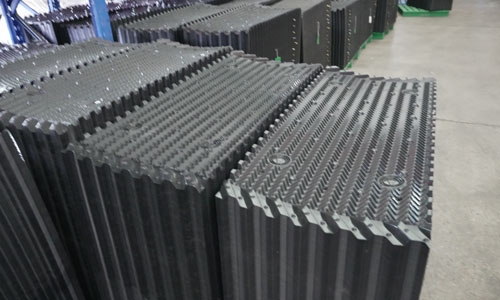
Corrugated designs direct water along structured pathways.
This ensures controlled and consistent distribution across the fill.
Corrugated fill is widely used due to its balanced performance.
Impact of Fill Structure Design on Water Behavior
The structure of cooling tower fill determines how water spreads and flows.
- Spacing between sheets affects flow speed and coverage
- Surface design influences water adhesion
- Inclination angle controls flow direction
An optimized cooling tower fill design ensures uniform coverage without excessive flow concentration.
Material Influence on Distribution Stability
PVC Cooling Tower Fill Standard Option
PVC cooling tower fill provides stable performance under normal conditions.
It supports consistent water spread but may be affected by high temperatures.
PP Cooling Tower Fill High Temperature Resistance
PP cooling tower fill maintains structural stability in higher temperature environments.
This helps sustain uniform distribution over extended operation periods.
Installation Factors That Affect Water Distribution
Proper Positioning
Incorrect positioning leads to uneven water flow across the fill.
Accurate alignment ensures effective cooling tower fill operation.
Structural Support Integrity
Weak supports may cause deformation or displacement.
This impacts both flow distribution and airflow paths.
Distribution System Compatibility
The spray system must match the fill structure.
Improper nozzle configuration can create uneven loading.
Methods to Improve Water Distribution Efficiency
Optimizing distribution requires both design and maintenance considerations.
- Select fill type based on operating conditions
- Match fill with spray system design
- Use appropriate materials for temperature range
- Ensure accurate installation
- Perform regular inspection
Using industrial cooling tower fill designed for specific applications improves system stability.
Engineering Cases Water Distribution Improvement
Industrial Cooling Imbalance Case
A facility experienced uneven cooling performance.
The issue was traced to non-uniform water distribution.Replacing the fill improved consistency.
High Temperature Operation Issue
A system under high temperature conditions showed irregular flow patterns.
Material deformation affected distribution.Upgrading to PP improved stability.
Contaminated Water System Adjustment
A plant handling poor water quality faced blockage issues.
Switching to a more open fill structure improved flow distribution.
Comparison Table Water Distribution Performance
| Fill Type | Uniformity | Clog Resistance | Application |
|---|---|---|---|
| Film Fill | High | Low | Clean water |
| Splash Fill | Moderate | High | Dirty water |
| Corrugated Fill | Balanced | Medium | Industrial use |
Conclusion Balanced Distribution Supports Stable Cooling
Uniform water distribution is essential for efficient cooling tower operation.
Selecting suitable Cooling tower fill improves heat exchange and system stability.
Proper design and installation reduce operational issues and enhance long-term reliability.
FAQ Cooling Tower Fill Distribution Topics
Why does uneven distribution occur
It is usually caused by design mismatch, installation errors, or spray system issues.
Which fill ensures best uniformity
Film fill provides the most even coverage under clean conditions.
Can distribution be improved without replacement
Minor issues can be corrected, but structural problems require new fill.
Does material affect performance
Yes. Material stability influences long-term distribution consistency.
Is corrugated fill a common choice
Yes. It offers a practical balance of performance and durability.
About the Author
Senior engineer specializing in cooling tower system optimization with extensive experience in fill structure and water flow analysis.
2026-3-6
2025-12-13