
Introduction Cooling Tower Efficiency Decline Requires Correct Fill Evaluation
In industrial cooling operations, a decrease in cooling capacity is not always caused by insufficient equipment size or mechanical problems.Many plants continue running with outdated internal packing, resulting in higher operating costs and unstable process temperatures.
During field inspections in Southeast Asia, Middle East, and East Asian industrial facilities, one common issue appears repeatedly: the cooling tower structure remains functional, but the internal heat exchange performance has gradually declined.
The condition of Cooling tower fill directly affects water distribution, air contact efficiency, and evaporation performance.When the fill becomes damaged, blocked, or unsuitable for operating conditions, the cooling system cannot achieve its original design capacity.
From practical engineering experience, replacing unsuitable packing at the right time can recover 15–25** of lost cooling performance and reduce unnecessary energy consumption.
What Is Cooling Tower Fill Internal Component Function
Cooling tower fill is the internal media installed between water distribution and airflow areas to improve heat transfer efficiency.It creates a larger contact area between circulating water and air, allowing more effective evaporation.
Unlike simple support materials, modern fill systems are designed with specific surface patterns, spacing, and airflow channels.These factors determine how evenly water spreads and how effectively heat is removed.
Industrial engineers often refer to this component as tower fill, while manufacturers may describe it as cooling tower fill media or packing material.
A suitable fill structure helps maintain stable cooling performance even when operating conditions change throughout the year.
Types of Cooling Tower Fill Used in Industrial Systems
Film Fill Efficient Water Film Formation
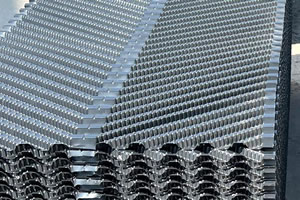
Film fill creates a thin layer of flowing water across specially designed surfaces.This increases the contact area between air and water and provides excellent heat transfer capability.
For clean water applications, film fill cooling tower systems are commonly selected because they provide high thermal efficiency with compact installation space.
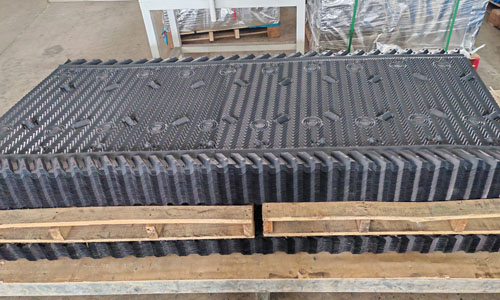
Modern designs often use corrugated fill patterns to improve water spreading and reduce uneven flow distribution.
Splash Fill Reliable Performance Under Difficult Conditions
Splash fill uses multiple impact points to break water streams into smaller droplets.This operating principle makes it less sensitive to suspended solids and contamination.
In industries where water contains impurities, splash fill cooling tower systems usually provide longer service intervals compared with fine structured film systems.
Applications include wastewater cooling, steel production, and other processes where water treatment conditions are challenging.
Corrugated Fill Advanced Structured Packing Design
Corrugated fill combines high heat transfer capability with improved airflow management.Its surface structure creates controlled turbulence that improves interaction between air and water.
Compared with traditional packing materials, this design offers more consistent performance during long-term operation.
Many modern industrial towers use corrugated structures as the main design choice for balancing efficiency and operating reliability.
Cooling Tower Fill Materials Selection Based on Working Conditions
PVC Cooling Tower Fill Cost Effective Industrial Solution
PVC cooling tower fill remains one of the most commonly used solutions because it provides good thermal performance at a reasonable cost.
It is suitable for many HVAC systems and industrial cooling applications where operating temperature and chemical exposure remain within normal ranges.
Installing PVC Cooling Tower Fill during renovation projects can restore lost performance caused by aging or damaged packing.
However, engineers should carefully evaluate temperature limits and environmental conditions before selecting PVC materials.
PP Cooling Tower Fill High Temperature Application Choice
PP cooling tower fill is preferred for applications requiring stronger temperature resistance and chemical stability.
Compared with PVC, PP provides better resistance against deformation in demanding industrial environments.
For chemical processing, power generation, and wastewater applications, PP is often selected as a long-term solution for Cooling tower fill replacement.
Performance and Efficiency Factors Affecting Cooling Results
The efficiency of a cooling tower depends on how effectively the fill controls water and airflow interaction.
Several engineering factors influence performance:
- Surface area available for evaporation
- Uniformity of water distribution
- Air resistance through internal channels
- Ability to resist fouling during operation
A properly selected Cooling tower fill can improve cooling capacity by 15–25** when replacing severely aged or unsuitable packing.
In tropical climates with high humidity, correct fill selection is especially important because small efficiency losses can affect the entire production process.
How to Choose Cooling Tower Fill for Industrial Projects
Selecting the right Cooling tower fill requires understanding actual operating conditions rather than choosing only based on price.
- Process water condition: clean water allows higher efficiency film designs
- Contamination level: polluted water requires stronger fouling resistance
- Temperature range: determines suitable material selection
- Maintenance plan: affects expected service life
A professional procurement decision should consider replacement frequency, cleaning requirements, and long-term operating cost.
For systems with heavy contamination, cooling tower fill for dirty water is usually a better choice than high-efficiency fine film structures.
Common Problems Affecting Cooling Tower Fill Performance
Cooling Tower Fill Clogged Problems
A cooling tower fill clogged condition usually develops from suspended solids, algae, dust, or poor water treatment.
Blocked passages reduce airflow and prevent water from contacting the full surface area.
Scaling Reduces Heat Transfer Ability
Mineral deposits create an insulating layer on fill surfaces.This reduces evaporation efficiency and increases operating temperature.
Regular water treatment is essential to control scaling development.
Aging Causes Structural Performance Loss
Long-term operation can cause material weakening due to heat, chemicals, and ultraviolet exposure.
Aged fill may become brittle, collapse, or lose its original flow characteristics.
Maintenance Tips for Longer Cooling Tower Fill Service Life
- Inspect internal fill condition regularly
- Monitor water quality changes
- Remove biological growth before serious blockage occurs
- Replace damaged sections before affecting the whole tower
Proper cooling tower fill maintenance helps maintain stable efficiency and prevents unexpected shutdowns.
Many industrial users extend fill lifespan significantly by combining inspection programs with proper water treatment.
Real Engineering Experience Industrial Project Cases
Southeast Asia Manufacturing Plant Project
A factory in Malaysia experienced rising cooling water temperature during peak production periods.Inspection found uneven water distribution caused by aged internal packing.
After replacing the damaged section with optimized fill media, cooling performance improved by approximately 18** and production stability increased.
Middle East High Temperature Cooling Project
A cooling system operating in a desert environment faced repeated performance reduction during summer months.
The original material could not maintain stable shape under high temperature conditions.After upgrading to a more suitable material structure, the system achieved more consistent operation.
Industrial Dirty Water Cooling Project
A wastewater cooling system experienced frequent blockage because of high suspended solid content.
After changing from conventional film packing to a more suitable splash structure, cleaning frequency was reduced and operating reliability improved.
Conclusion Cooling Tower Fill Selection Determines Long Term Performance
Choosing the correct Cooling tower fill is one of the most important decisions in cooling tower operation.
The right structure and material selection improve heat transfer efficiency, reduce maintenance problems, and support stable industrial production.
For customers in Southeast Asia, Middle East, Japan, and Korea, engineers should evaluate water quality, temperature conditions, and operating environment before making replacement decisions.
A well-designed fill system provides reliable cooling performance throughout the equipment lifecycle.
FAQ Cooling Tower Fill Common Questions
When should cooling tower fill be replaced
Replacement is usually required when fill becomes damaged, heavily scaled, or unable to maintain expected cooling performance.
Can new cooling tower fill improve efficiency
Yes. Replacing aged or unsuitable packing can recover 15–25** performance depending on the original condition.
Is PP better than PVC cooling tower fill
PP provides better resistance in high temperature and chemical environments, while PVC is suitable for standard applications.
Which cooling tower fill is suitable for dirty water
Splash-based designs are generally more suitable because they provide better resistance against blockage.
How to maintain cooling tower fill
Regular inspection, water treatment control, and timely cleaning are essential for extending service life.
About the Author
Senior Cooling Tower Engineer with more than 10 years of experience in industrial cooling system optimization, fill replacement projects, and performance improvement programs across Southeast Asia, Middle East, Japan, and Korea.Focused on practical engineering solutions for improving cooling reliability, reducing maintenance issues, and extending equipment service life.
2026-4-12
2025-12-17
Crossflow Film Fill, Cooling T...
2025-12-9
Guide to Cooling Tower Fill Sp...
2025-11-29