
Readers, you've probably heard the term "water loss in cooling towers." In the field of cooling towers, water loss plays a crucial role in maintaining their efficiency.
As you know, a cooling tower is a device used for heat exchange. Water is an essential component in cooling production processes. The primary function of a cooling tower is to extract water from the production process. Heat exchange occurs through a process within the cooling element, turning hot water into cold water, which results in water loss.
In a cooling tower, the first type of water loss is called evaporation loss, or simply evaporation loss, referring to the water lost as it evaporates into steam. The second type of water loss refers to the small amount of water vapor blown away by the wind during the cooling process. The final type, called runoff loss, is water released by the cooling tower to maintain the chemical balance of the water. To compensate for the water loss in the cooling tower, we need to add new water. This newly added clean water is called makeup water.
You might be wondering, how do we know how much water to add for cooling? There's a way of thinking about it. What kind of water calculation helps balance the water loss in the cooling tower? How do we calculate the cooling water to ensure the efficient operation of the cooling system within the cooling tower?
Before we get to the main topic, let me briefly introduce myself. We've written many articles, and if any of you are reading this as your first, you'll recognize us. You can skip this part.
We are a cooling tower manufacturer from China. It meets global standards. We have a team with over 15 years of experience and expertise in products and services, providing a full range of services from cooling tower design and installation to inspection and maintenance (one-stop cooling tower service provider).
Why Calculate Water Loss in Cooling Towers?
For many engineers, calculating the amount of water lost from the cooling tower is crucial for maintaining its efficient operation. As I mentioned in the article above regarding efficient operation and cost-effectiveness of cooling towers,
some people already know this, but for those who don't, evaporation loss is the largest water loss compared to other types of loss, accounting for 1** to 1.5** of total water loss. The chemicals or minerals in the water don't disappear. This means that water is lost every time. The concentration of chemicals or minerals in the water will be higher. Therefore, the possibility of scaling increases, requiring water to be blown down or drained and replenished with makeup water. If there is no makeup water to dilute it... No water is added to the cooling tower to maintain water balance, and harmful pollutants may accumulate.
Slag in the cooling tower
Now that you know why you need to calculate water, you need to know why you need to calculate water in the first place. Next, let's see how to calculate each type of water loss.
Cooling tower evaporation steam
Cooling tower evaporation loss calculation
Evaporation loss = 0.00085 × 1.8 × Water flow rate (m³/h) × (Hot water temperature - Cold water temperature)
The values used to represent the water flow rate in the calculation can be found in the cooling tower's data sheet.
Assume the following figures are in the cooling tower data sheet:
Cooling tower water flow rate 10,000 m³/h
Hot water temperature 42°C
Cold water temperature 32°C
Substitute the values in the formula to calculate how much water is lost due to evaporation.
Evaporation loss = 0.00085 X 1.8 X 10,000 X (42-32)
= 153 cubic meters/hour
Important Note: Evaporative water loss due to evaporation (EVAP) is already part of the cooling tower's water loss. It cannot be reduced.
Cooling Tower Drift Loss Calculation (Water Lost Due to Wind)
Drift Loss = Drift Loss Rate (**) x Water Flow (cubic meters/hour) ÷ 100
The values used to replace the values in the water calculation can also be found in the cooling tower's datasheet.
An example of hypothetical data from a cooling tower datasheet is as follows:
Cooling tower water flow rate 10,000 cubic meters/hour, Drift loss rate 0.002** of water flow
representing the value in the equation to calculate how much water is lost due to wind.
Assuming your cooling tower datasheet has the following figures:
Cooling tower water flow rate 10,000 cubic meters/hour, Drift loss rate 0.002** of water flow
representing the value in the equation to calculate how much water is lost due to wind.
Drift Loss = 0.002 x 10000 ÷100 = 0.2 cubic meters/hour
Important Note: Choosing a drift eliminator suitable for your application can reduce drift losses.
The calculation of drift losses depends on the type of drift eliminator installed in the cooling tower.
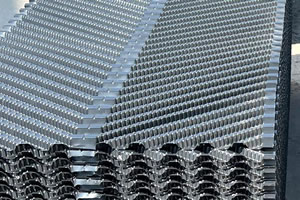
Image 3: Drift Eliminator
Cooling Tower Drainage Loss (Drainage Loss) Calculation
Downward Pressure Loss = Evaporation Loss ÷ (C.O.C - 1)
Where C.O.C. is the concentration cycle, i.e., the volume of solution in the cooling water divided by the volume of solution. Makeup Water
Solution Note: Makeup water refers to the water that must be added as circulating water in the cooling tower system to replenish lost water.
If running 2 cycles until the silicon content in the water reaches 2 × 100 = 200 ppm; if running 5 cycles until the silicon content in the water is 5 × 100 = 500 ppm, then set C.O.C. = 5, and then blow water down the cooling tower,
not the value in the equation, to determine the amount of wastewater discharge loss
. Downward Pressure Loss = 153 cubic meters/hour ÷ (5-1)= 38.25 cubic meters/hour
Important Note: Exhaust losses are inevitable for cooling towers, just like EVAP losses, which are an unavoidable form of moisture loss.
Calculation of Total Water Loss in Cooling Towers
Total Water Loss = Evaporation Loss + Drift Loss + Downflow Loss
By substituting the values in the equation, we can determine the losses caused by wastewater discharge.
Total Water Loss = 153 + 0.2 + 38.25 = 191.45 cubic meters/hour = 1.57**
Once we know the water volume, we can determine how much water needs to be added. What we need to do is find a sufficient water reserve to fill the cooling tower. We won't see how the cooling system stops working, but it's certain that cooling systems that typically consume a lot of electricity will consume even more electricity and waste energy unnecessarily. Calculating water loss to determine the amount of water needed for replenishment is an essential part of cooling tower maintenance. A longer cooling tower lifespan and more efficient operation also reduce energy consumption, electricity bills, and overall cost, making it more environmentally friendly.
Typically, cooling tower service providers have already calculated water loss using the formula mentioned above. However, the purpose of this article is to inform all readers. If you encounter unusual water loss issues or other cooling water-related problems, you can calculate the water loss yourself based on your understanding of water loss and the need to add water to your cooling tower system. You don't need to pay a cooling tower service provider to investigate.
We sincerely hope this article is helpful. If you have any questions about cooling towers or ideas for our next article, suggestions, and discussions can be submitted via email to chenhan199966@gmail.com. We offer free consultation/answers! Free
As you know, a cooling tower is a device used for heat exchange. Water is an essential component in cooling production processes. The primary function of a cooling tower is to extract water from the production process. Heat exchange occurs through a process within the cooling element, turning hot water into cold water, which results in water loss.
In a cooling tower, the first type of water loss is called evaporation loss, or simply evaporation loss, referring to the water lost as it evaporates into steam. The second type of water loss refers to the small amount of water vapor blown away by the wind during the cooling process. The final type, called runoff loss, is water released by the cooling tower to maintain the chemical balance of the water. To compensate for the water loss in the cooling tower, we need to add new water. This newly added clean water is called makeup water.
You might be wondering, how do we know how much water to add for cooling? There's a way of thinking about it. What kind of water calculation helps balance the water loss in the cooling tower? How do we calculate the cooling water to ensure the efficient operation of the cooling system within the cooling tower?
Before we get to the main topic, let me briefly introduce myself. We've written many articles, and if any of you are reading this as your first, you'll recognize us. You can skip this part.
We are a cooling tower manufacturer from China. It meets global standards. We have a team with over 15 years of experience and expertise in products and services, providing a full range of services from cooling tower design and installation to inspection and maintenance (one-stop cooling tower service provider).
Why Calculate Water Loss in Cooling Towers?
For many engineers, calculating the amount of water lost from the cooling tower is crucial for maintaining its efficient operation. As I mentioned in the article above regarding efficient operation and cost-effectiveness of cooling towers,
some people already know this, but for those who don't, evaporation loss is the largest water loss compared to other types of loss, accounting for 1** to 1.5** of total water loss. The chemicals or minerals in the water don't disappear. This means that water is lost every time. The concentration of chemicals or minerals in the water will be higher. Therefore, the possibility of scaling increases, requiring water to be blown down or drained and replenished with makeup water. If there is no makeup water to dilute it... No water is added to the cooling tower to maintain water balance, and harmful pollutants may accumulate.
Slag in the cooling tower
Now that you know why you need to calculate water, you need to know why you need to calculate water in the first place. Next, let's see how to calculate each type of water loss.
Cooling tower evaporation steam
Cooling tower evaporation loss calculation
Evaporation loss = 0.00085 × 1.8 × Water flow rate (m³/h) × (Hot water temperature - Cold water temperature)
The values used to represent the water flow rate in the calculation can be found in the cooling tower's data sheet.
Assume the following figures are in the cooling tower data sheet:
Cooling tower water flow rate 10,000 m³/h
Hot water temperature 42°C
Cold water temperature 32°C
Substitute the values in the formula to calculate how much water is lost due to evaporation.
Evaporation loss = 0.00085 X 1.8 X 10,000 X (42-32)
= 153 cubic meters/hour
Important Note: Evaporative water loss due to evaporation (EVAP) is already part of the cooling tower's water loss. It cannot be reduced.
Cooling Tower Drift Loss Calculation (Water Lost Due to Wind)
Drift Loss = Drift Loss Rate (**) x Water Flow (cubic meters/hour) ÷ 100
The values used to replace the values in the water calculation can also be found in the cooling tower's datasheet.
An example of hypothetical data from a cooling tower datasheet is as follows:
Cooling tower water flow rate 10,000 cubic meters/hour, Drift loss rate 0.002** of water flow
representing the value in the equation to calculate how much water is lost due to wind.
Assuming your cooling tower datasheet has the following figures:
Cooling tower water flow rate 10,000 cubic meters/hour, Drift loss rate 0.002** of water flow
representing the value in the equation to calculate how much water is lost due to wind.
Drift Loss = 0.002 x 10000 ÷100 = 0.2 cubic meters/hour
Important Note: Choosing a drift eliminator suitable for your application can reduce drift losses.
The calculation of drift losses depends on the type of drift eliminator installed in the cooling tower.
Image 3: Drift Eliminator
Cooling Tower Drainage Loss (Drainage Loss) Calculation
Downward Pressure Loss = Evaporation Loss ÷ (C.O.C - 1)
Where C.O.C. is the concentration cycle, i.e., the volume of solution in the cooling water divided by the volume of solution. Makeup Water
Solution Note: Makeup water refers to the water that must be added as circulating water in the cooling tower system to replenish lost water.
If running 2 cycles until the silicon content in the water reaches 2 × 100 = 200 ppm; if running 5 cycles until the silicon content in the water is 5 × 100 = 500 ppm, then set C.O.C. = 5, and then blow water down the cooling tower,
not the value in the equation, to determine the amount of wastewater discharge loss
. Downward Pressure Loss = 153 cubic meters/hour ÷ (5-1)= 38.25 cubic meters/hour
Important Note: Exhaust losses are inevitable for cooling towers, just like EVAP losses, which are an unavoidable form of moisture loss.
Calculation of Total Water Loss in Cooling Towers
Total Water Loss = Evaporation Loss + Drift Loss + Downflow Loss
By substituting the values in the equation, we can determine the losses caused by wastewater discharge.
Total Water Loss = 153 + 0.2 + 38.25 = 191.45 cubic meters/hour = 1.57**
Once we know the water volume, we can determine how much water needs to be added. What we need to do is find a sufficient water reserve to fill the cooling tower. We won't see how the cooling system stops working, but it's certain that cooling systems that typically consume a lot of electricity will consume even more electricity and waste energy unnecessarily. Calculating water loss to determine the amount of water needed for replenishment is an essential part of cooling tower maintenance. A longer cooling tower lifespan and more efficient operation also reduce energy consumption, electricity bills, and overall cost, making it more environmentally friendly.
Typically, cooling tower service providers have already calculated water loss using the formula mentioned above. However, the purpose of this article is to inform all readers. If you encounter unusual water loss issues or other cooling water-related problems, you can calculate the water loss yourself based on your understanding of water loss and the need to add water to your cooling tower system. You don't need to pay a cooling tower service provider to investigate.
We sincerely hope this article is helpful. If you have any questions about cooling towers or ideas for our next article, suggestions, and discussions can be submitted via email to chenhan199966@gmail.com. We offer free consultation/answers! Free
2026-4-12
2025-12-17
Crossflow Film Fill, Cooling T...
2025-12-9
Guide to Cooling Tower Fill Sp...
2025-11-29