
I. The Importance and Basic Functions of Cooling Tower Fill
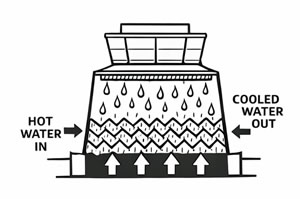
Cooling tower fill is the "heart" of the cooling system, directly influencing cooling efficiency, energy consumption, and equipment lifespan. By significantly increasing the contact area between water and air, the fill promotes efficient heat exchange. Selecting the right cooling tower fill and maintaining it correctly can significantly reduce operating costs and extend the service life of the equipment.
II. Detailed Explanation of Main Cooling Tower Fill Types
1. Film Fill
Structure and Characteristics
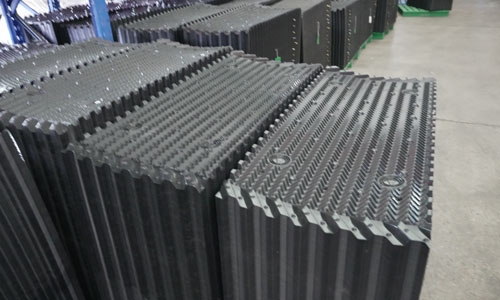
This type uses a dense corrugated sheet structure where water flows in a thin film over the surface, and air contacts the water film through the channels.
Applicable Scenarios
Industrial circulating water systems, central air conditioning, and other scenarios requiring high efficiency. Depending on the direction of airflow and water flow, it is mainly divided into Counterflow Film Fill and Crossflow Film Fill.
Advantages and Limitations
High heat exchange efficiency and low resistance; however, it has high requirements for water quality and is prone to clogging.
2. Splash Fill
Structure and Characteristics
This type adopts a grid or fence structure where water falls in droplets or thin streams, and air contacts the water droplets in the gaps. Splash Grid Fill is a highly efficient form of this, which effectively prevents water droplets from splashing out and improves heat exchange.
Applicable Scenarios
Industrial environments with poor water quality containing suspended solids, or for retrofitting older towers.
Advantages and Limitations
Strong resistance to clogging and simple maintenance; however, the cooling efficiency is relatively lower.
3. Composite Fill
Structure and Characteristics
Combines the advantages of film and splash types, often in a combined or special hybrid structure to balance efficiency and reliability.
Applicable Scenarios
Situations where water quality fluctuates greatly, requiring a balance between efficiency and resistance to clogging.
Advantages and Limitations
Excellent comprehensive performance and strong adaptability; relatively higher cost.
4. Special Material Fill
Common Types
- PVC cooling tower fill: Economical, practical, and corrosion-resistant. It is suitable for general water quality and is the most mainstream choice in the market.
- PP Cooling Tower Fill: Offers better temperature resistance, making it suitable for systems with higher water temperatures. It has a low deformation rate in high-temperature environments.
- Ceramic/Stainless Steel Fill: Corrosion-resistant and high strength, suitable for special chemical environments or harsh operating conditions.
III. Practical Buying Guide for Fill
1. Clarify Your Needs
Assess your cooling tower type (Crossflow, Counterflow), water quality conditions (hardness, suspended solids, pH value), process requirements (target temperature, temperature difference), and environmental factors (ambient temperature and humidity).
2. Key Performance Indicators
Focus on heat exchange efficiency (heat exchange area per unit volume), ventilation resistance (affects fan energy consumption), flame retardant properties, temperature resistance range, and service life.
3. Cost-Benefit Analysis
Comprehensively consider initial procurement costs, installation fees, long-term operating energy consumption, maintenance costs, and replacement cycles to achieve optimal costs over the entire lifecycle.
4. Supplier Selection Points
Check the manufacturer's qualifications and industry experience. Whenever possible, request samples for testing, understand their after-sales service and technical support capabilities, and refer to existing customer feedback.
IV. Daily Care and Maintenance Precautions
1. Regular Inspection Plan
- Daily: Observe if the water flow is uniform and listen for any abnormal noises.
- Weekly: Check the fill surface for damage or algae growth.
- Monthly: Comprehensively check for clogging and measure changes in cooling efficiency.
2. Common Issues Handling
- Clogging: For mild cases, increase blowdown; moderate cases require chemical or high-pressure cleaning; severe cases require replacement.
- Scaling: Regularly add scale inhibitors, control the concentration ratio of circulating water, and optimize the water source.
- Aging and Damage: Timely repair small areas of damage and record aging conditions to plan for replacement.
3. Seasonal Maintenance Focus
- Summer: Increase inspection frequency, ensure the spray system is normal, and closely monitor efficiency.
- Winter: Focus on freeze protection. Drain part of the water if necessary and pay attention to the impact of low temperatures on materials.
V. Fill Replacement Process Detailed
1. Judging the Timing for Replacement
Replacement should be considered when cooling efficiency drops by more than 15**, physical damage to the fill exceeds 20**, performance cannot be restored after cleaning, or the service life limit is reached.
2. Preparation Work
- Safety First: Cut off power and lock out the system, drain water from the tower, and wear personal protective equipment.
- Tools and Materials: Prepare new fill with matching specifications, specialized cutting tools, installation fixtures, and cleaning tools.
3. Replacement Steps
- Remove Old Fill: Dismantle in sections from top to bottom, protecting the tower structure, and thoroughly clean the installation area.
- Install New Fill: Install in layers according to the design, ensuring neat arrangement and secure fixation.
- Quality Check: Check installation flatness and uniformity of water flow distribution to ensure no omissions.
4. Post-Replacement Commissioning
Gradually restore water supply to check for leaks, adjust the spray system, monitor the recovery of cooling efficiency, and record performance data before and after replacement.
VI. Summary and Suggestions
The management of cooling tower fill is a systematic engineering task involving efficiency, cost, and safety. We offer the following core suggestions:
- Establish Archives: Detailed records of fill parameters, installation times, and all maintenance history.
- Regular Assessment: Systematically analyze cooling efficiency trends quarterly to prevent problems before they occur.
- Prevention First: Develop and strictly execute preventive maintenance plans to avoid unplanned downtime.
- Professional Consultation: Consult professional technicians before making major decisions to leverage their experience.
- Focus on Development: Continuously stay informed about new industry materials and technologies for energy-saving optimization.
If you have any questions, or if you would like to send us drawings or samples for analysis, please do not hesitate to reach out. You can Contact Us for professional assistance.
2026-3-6
2025-12-13