
What Is the Fill Material in a Cooling Tower?
When we talk about cooling tower performance, many people focus on fan power, water flow rate, or approach temperature. But in real operation, the fill material inside the cooling tower plays a much bigger role than most people expect.
In simple terms, cooling tower fill material determines how effectively heat is transferred from water to air, how long the fill can last, and how much maintenance the system will require over its lifetime.
From my experience working with cooling towers across Southeast Asia — including industrial plants, commercial HVAC systems, and power stations — choosing the wrong fill material often leads to premature failure, scaling issues, or unstable cooling performance.
Why Fill Material Matters More Than You Think
The fill material is the foundation of all Cooling Tower Media. Even the best fill design will fail if the material cannot handle the actual operating conditions.
Key Factors Influenced by Fill Material
- Heat transfer efficiency
- Resistance to temperature and chemicals
- Mechanical strength and deformation risk
- Service life and replacement cycle
- Maintenance frequency and cleaning difficulty
In hot and humid climates, material selection becomes even more critical because the cooling tower often operates close to its design limits.
Main Materials Used in Cooling Tower Fill
PVC Cooling Tower Fill
PVC is the most commonly used material for Film Fill Cooling Tower applications worldwide. It provides excellent heat transfer performance at a reasonable cost, making it the first choice for many standard cooling towers.
Why PVC Is Widely Used
- Smooth surface promotes uniform water film formation
- Good chemical resistance for treated water
- Lightweight and easy to install
- Cost-effective for large-scale projects
Temperature and Operating Limits
PVC cooling fill typically works well at continuous operating temperatures up to 55–60°C. For HVAC systems and most industrial applications, this is sufficient.
However, in systems with high return water temperature or frequent thermal shocks, PVC may soften or deform over time.
Best Applications for PVC Fill
- Commercial HVAC cooling towers
- Manufacturing plants with stable water quality
- Retrofit projects where efficiency improvement is required
PP Cooling Tower Fill
PP Cooling Tower Fill is designed for harsher conditions where PVC may not perform reliably. It is commonly used in heavy industrial cooling towers.
Key Advantages of PP Material
- Higher temperature resistance (up to 80–90°C depending on grade)
- Better resistance to deformation
- Higher mechanical strength
- Longer service life in aggressive environments
Typical Use Cases for PP Fill
- Power plants
- Petrochemical facilities
- Steel and metal processing plants
- Cooling towers with poor water quality
Fill Material Selection Based on Cooling Tower Type
Counterflow Cooling Towers
Counterflow towers usually operate with higher air velocity and water loading. For this reason, fill material must be dimensionally stable and resistant to long-term stress.
PVC is commonly used for standard counterflow systems, while PP is preferred for high-temperature or heavy-duty designs.
Crossflow Cooling Towers
Crossflow cooling towers rely on gravity water distribution and require fill materials that maintain consistent spacing and airflow paths.
In crossflow systems, material flatness and structural integrity are especially important to avoid airflow bypass and uneven cooling.
Corrugated Fill Structure and Material Interaction
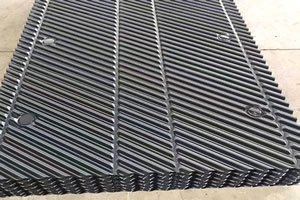
Most modern Cooling Tower Fill uses corrugated sheets. The effectiveness of this Corrugated Fill design depends heavily on the material used.
Important Structural Parameters
- Sheet thickness
- Flute angle
- Sheet spacing (19mm, 23mm, or customized)
- Surface texture
PVC typically allows finer spacing for higher efficiency, while PP may require slightly wider spacing for structural stability.
Water Quality and Material Compatibility
Water quality is often overlooked during fill material selection. In Southeast Asia, water sources vary greatly, which directly impacts fill lifespan.
Common Water-Related Issues
- Scaling due to high hardness
- Biological growth in warm water
- Oil or suspended solids from industrial processes
In systems with poor water quality, PP fill or even Splash Grid Fill may be a safer long-term solution.
Maintenance Considerations by Fill Material
PVC Fill Maintenance
- Requires consistent water treatment
- Periodic inspection for scaling
- More sensitive to fouling
PP Fill Maintenance
- More tolerant of harsh conditions
- Longer cleaning intervals
- Lower risk of deformation
Related Cooling Tower Components
Fill material performance is closely linked with other cooling tower components:
Summary
The fill material inside a cooling tower is not just a structural choice — it is a long-term operational decision. PVC and PP each have their strengths, and the right selection depends on temperature, water quality, tower design, and maintenance capability.
Need Expert Advice on Fill Material Selection?
If you are unsure which fill material is suitable for your cooling tower, simply send us your drawings, operating conditions, or photos. Our experienced engineers will provide practical recommendations.
Contact Us for Professional Support
2026-3-12
2026-1-30
Cooling Tower Fill Maintenance...
2025-12-22
Comparison Guide: Counterflow ...
2025-12-10