
Cooling Tower Fill Lifespan: What Really Determines Service Life in Industrial Applications?
Introduction: Why Lifespan Matters More Than Purchase Price
When buyers compare Cooling Tower Fill options, the first question is usually price. The second question is thermal performance. Very few buyers start by asking the most important question: how long will the fill actually last under real operating conditions?
In industrial cooling systems, Cooling Tower Fill is not a decorative component. It is the core heat exchange surface inside the tower. Once degradation begins, efficiency drops gradually. Most systems do not fail suddenly. Instead, performance declines slowly, leading to higher fan energy consumption, increased water usage, and reduced cooling capacity.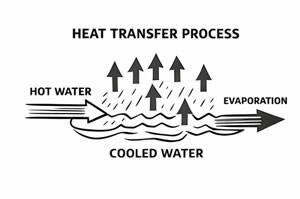
The real cost of Cooling Tower Fill is not the purchase price. It is the total lifecycle cost, which includes:
- Initial material cost
- Installation labor
- Maintenance frequency
- Cleaning downtime
- Replacement interval
- System efficiency loss over time
Understanding Cooling Tower Fill lifespan requires a systematic view of material science, structural stability, water chemistry, airflow distribution, and environmental exposure.
Average Cooling Tower Fill Lifespan: Industry Expectations vs Reality
Many suppliers claim 8–10 years of lifespan for PVC cooling tower fill. In practice, actual service life varies significantly depending on:
- Water temperature
- Water hardness and scaling tendency
- Biological fouling risk
- UV exposure (for rooftop towers)
- Airborne dust and industrial contamination
- Mechanical load and vibration
In HVAC commercial systems with treated water and moderate temperature, Cooling Tower Fill may indeed last 8–12 years. However, in heavy industrial environments such as steel mills, petrochemical plants, and mining operations, lifespan may drop to 3–5 years if material selection is incorrect.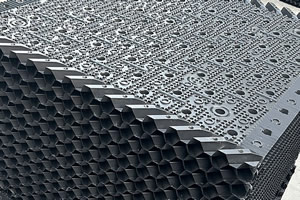
Material Selection: PVC vs PP Cooling Tower Fill
PVC Cooling Tower Fill
PVC cooling tower fill is widely used because it offers good balance between cost and thermal efficiency. It provides:
- Good formability for complex corrugated structures
- Reasonable heat resistance (typically up to 50–55°C continuous)
- Cost efficiency
However, PVC softens when exposed to prolonged high temperatures. If circulating water temperature remains above 50°C for extended periods, sheet deformation may occur. Once structural geometry changes, airflow resistance increases and heat transfer efficiency declines.
PP Cooling Tower Fill
PP Cooling Tower Fill provides better thermal stability. It can withstand higher continuous temperatures, often up to 70–80°C depending on grade.
Industrial sectors that commonly choose PP include:
- Petrochemical plants
- Power generation facilities
- Steel production cooling systems
- Chemical processing plants
Although PP material cost is higher, lifespan under harsh conditions may justify the investment.
Structural Design Impact on Cooling Tower Fill Lifespan
Material is only one part of the equation. Structural design of the Cooling Tower Media strongly influences durability.
Sheet Thickness
Thin sheets improve heat transfer due to larger effective surface area and lower airflow resistance. However, excessively thin material may:
- Lose rigidity under heat
- Warp under mechanical load
- Sag between support beams
Proper thickness selection balances thermal efficiency and mechanical stability.
Corrugation Angle and Spacing
Film Fill Cooling Tower structures use corrugated sheets to create turbulence and maximize contact surface. Narrow spacing increases heat transfer efficiency but also increases clogging risk in high-scaling water.
Over time, scale buildup reduces open flow area. This increases static pressure and may strain fan systems.
Water Quality: The Silent Lifespan Killer
Even premium Cooling Tower Fill will degrade rapidly under poor water management. Water quality factors include:
- Total dissolved solids (TDS)
- Calcium hardness
- Silica content
- Biological contamination
- Suspended solids
Scaling deposits reduce effective heat transfer surface and add mechanical weight to fill sheets. Biological fouling forms biofilm layers that block channels and reduce airflow.
In regions with hard water, Splash Grid Fill may outperform Film Fill over long periods due to its open structure and clog resistance.
UV Exposure and Environmental Conditions
Rooftop cooling towers in tropical and desert climates experience intense UV radiation. Over time, UV exposure can cause brittleness in certain PVC formulations if UV stabilizers are insufficient.
Industrial dust and airborne particles also accelerate fouling and surface abrasion.
Mechanical Factors That Reduce Service Life
Cooling Tower Fill is not static. It operates in a dynamic environment:
- Fan-induced vibration
- Thermal expansion and contraction cycles
- Water load fluctuations
- Maintenance handling damage
Improper support beam spacing or weak installation can cause sagging and structural fatigue.
How to Extend Cooling Tower Fill Lifespan
Extending service life requires coordinated engineering approach:
- Confirm maximum continuous water temperature
- Select correct material (PVC or PP)
- Match fill type to water quality
- Ensure uniform airflow distribution
- Maintain proper chemical treatment program
- Schedule periodic inspection and cleaning
Cooling Tower Fill lifespan is not random. It is predictable when system conditions are understood.
Lifecycle Cost Analysis of Cooling Tower Fill
When evaluating Cooling Tower Fill lifespan, a practical method is lifecycle cost modeling rather than focusing only on initial material cost.
The lifecycle cost of Cooling Tower Fill includes:
- Initial purchase price
- Transportation and logistics
- Installation labor cost
- System downtime during installation
- Cleaning and maintenance cost
- Energy consumption changes due to efficiency loss
- Replacement frequency
For example, if a lower-cost PVC cooling tower fill lasts only 4 years in high-temperature industrial conditions, while a PP Cooling Tower Fill lasts 8 years, the annualized cost difference may strongly favor PP, even if initial purchase cost is higher.
In many industrial cooling systems, fan energy accounts for a significant portion of operational cost. When Cooling Tower Media becomes clogged or deformed, airflow resistance increases. Fans must operate at higher load to maintain cooling capacity.
Even a small increase in static pressure can significantly increase power consumption over time.
Energy Impact of Degraded Cooling Tower Fill
Heat transfer efficiency depends on proper contact between water and air. When Film Fill Cooling Tower structures begin to clog due to scaling or biological growth, two things happen:
- Water distribution becomes uneven
- Air velocity distribution becomes unstable
This leads to higher approach temperature and reduced cooling efficiency. To compensate, operators may:
- Increase fan speed
- Run additional cooling cells
- Increase water circulation rate
Each of these actions increases energy consumption.
In long-term operation, degraded Cooling Tower Fill may indirectly increase annual energy cost by 5–15** depending on system size.
Case Study Comparison: HVAC vs Heavy Industry
Commercial HVAC System
Typical office building cooling tower:
- Water temperature: 30–35°C
- Treated water with low hardness
- Stable load pattern
- Limited industrial dust exposure
Under these conditions, PVC cooling tower fill may easily achieve 8–12 years of service life with proper maintenance.
Steel Plant Cooling System
Industrial steel production cooling tower:
- Water temperature: 45–60°C continuous
- High suspended solids
- Oil contamination risk
- High dust environment
In this environment, standard Film Fill may clog within 2–3 years if not designed for dirty water. Splash Grid Fill or high-temperature PP Cooling Tower Fill may provide more reliable long-term stability.
When Should Cooling Tower Fill Be Replaced?
Replacement should not wait until catastrophic failure. Signs that Cooling Tower Fill has reached end of service life include:
- Noticeable increase in approach temperature
- Fan operating at higher power continuously
- Visible deformation or sagging
- Severe scale buildup that cannot be cleaned effectively
- Brittle cracking of fill sheets
Waiting too long increases overall operational risk.
Failure Analysis: What Usually Goes Wrong
Thermal Deformation
Continuous exposure to high water temperature softens PVC structure.
Scale Overload
Excess mineral deposits increase weight and block channels.
Biological Fouling
Algae and biofilm reduce effective heat exchange area.
Mechanical Sagging
Improper support spacing allows Film Fill blocks to deform over time.
Choosing the Right Cooling Tower Fill for Maximum Lifespan
The following engineering checklist helps extend Cooling Tower Fill service life:
- Confirm maximum continuous operating temperature
- Review water analysis report
- Select appropriate fill structure (Film Fill or Splash Grid Fill)
- Verify structural thickness and rigidity
- Ensure proper airflow distribution
- Implement scheduled inspection and cleaning plan
Cooling Tower Fill lifespan is a predictable outcome of engineering decisions. It is not random, and it should not rely solely on supplier claims.
Conclusion: Service Life Is an Engineering Decision
Cooling Tower Fill is the heart of heat exchange inside the tower. Its lifespan depends on material science, structural integrity, water chemistry, airflow design, and maintenance strategy.
Choosing the right Cooling Tower Fill at the beginning can reduce lifecycle cost, stabilize thermal performance, and protect long-term system efficiency.
- PVC Cooling Tower Fill
- PP Cooling Tower Fill
- Splash Grid Fill
- Counterflow Film Fill
Need help evaluating your Cooling Tower Fill lifespan?
Send us your operating temperature, water quality data, and tower type. Our engineers can help estimate expected service life and recommend the most stable solution.
Contact Us
2026-4-12
2025-12-17
Crossflow Film Fill, Cooling T...
2025-12-9
Guide to Cooling Tower Fill Sp...
2025-11-29