In the world of Cooling tower Fill, two materials dominate the market: PVC (Polyvinyl Chloride) and PP (Polypropylene). If you are running a standard HVAC system in a shopping mall, the choice is easy. But if you are managing a chemical plant in Jubail or a steel mill in Pohang, picking the wrong material can lead to catastrophic failure.
I’ve seen tower fill melt into a solid plastic block because an engineer didn't account for a process upset that spiked water temperatures. Let’s avoid that. Let's talk about the real differences between these Cooling Tower Media types.
The Standard: PVC Cooling Tower Fill
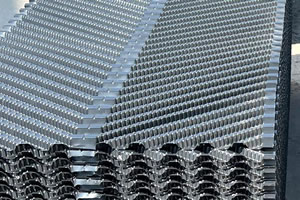
PVC cooling tower fill is the industry workhorse. It is rigid, easy to form into complex Corrugated Fill shapes, and has excellent fire retardant properties (self-extinguishing).
When to use PVC:
- Your water temperature is consistently below 50°C - 55°C.
- You are on a standard budget (PVC is more economical).
- You need material that is naturally resistant to many common biological growths.
However, PVC becomes brittle over many years, especially in cold climates, and it loses structural strength quickly as temperatures approach 60°C.
The Heavy Duty Option: PP Cooling Tower Fill
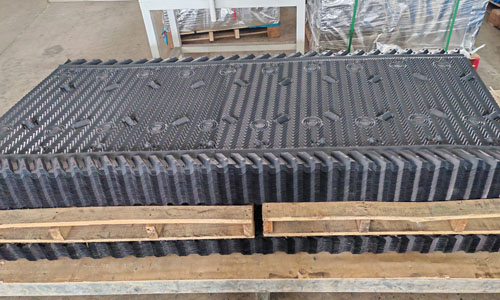
PP Cooling Tower Fill is the tough guy of the group. It is semi-crystalline and naturally more flexible and heat resistant than PVC.
When to use PP:
- High Heat: If your return water hits 60°C, 70°C, or even 80°C (176°F), you absolutely need PP. PVC will soften and collapse.
- Aggressive Water: PP has better chemical resistance to certain acids and alkalis compared to PVC.
- Cold Impact: PP is less likely to shatter in freezing conditions during maintenance.
Fill Structure: Film vs. Splash in Relation to Material
While material is important, structure determines clogging.
Film Fill (High Efficiency)
Both PVC and PP can be made into Film Fill. This is where we bond sheets to create flutes. For clean to moderately clean water, this is your best choice for maximum cooling per square meter.
Splash Grid (Dirty Water)
If your water is full of suspended solids, like in a sugar refinery or a paper mill, film fill will clog regardless of whether it is PVC or PP. Here, you need Splash Grid Fill. These are usually made of PP because splash grids are often used in harsher industrial environments where high temps and chemicals are present.
Buying Tips: Visual Checks
When you receive your Cooling Fill, check the bonding points.
For PVC, we use a solvent bond that essentially welds the plastic together.
For PP, since it resists solvents, we use a thermal welding technique (heat bonding). If you see PP fill that is just "glued" with standard adhesive, send it back—it won't hold.
Performance & Efficiency
Does material affect cooling efficiency? Indirectly, yes. PVC sheets can be made thinner and more rigid, allowing for slightly more intricate flute designs (like our high-efficiency Counterflow Film Fill). PP sheets are usually slightly thicker. However, the longevity of PP in harsh conditions ensures that the efficiency stays stable for longer, whereas PVC might degrade in that same harsh environment.
Maintenance of Different Materials
Cleaning PVC requires care; high-pressure washers can damage brittle sheets. PP is more forgiving to mechanical cleaning. Regardless of material, ensure your Drift Eliminators are functioning to keep that chemically treated water inside the tower.
Summary
Don't just copy-paste the specs from your last project. Look at your current water analysis and temperature logs. If you are pushing the limits of heat, go with PP. If you want cost-effective performance for standard AC or light industry, PVC is perfect.
Unsure if your water is too hot for PVC?
Send us your water temperature data and a brief description of your industrial process. We can simulate the thermal load and tell you definitively whether you need PVC or PP. Avoid the risk of meltdown!
Get expert material advice now.