
Normal Operating Condition of the Cooling Tower Fill Layer
Before we enter today’s case, first clarify the state of the cooling tower fill layer under normal operating conditions.
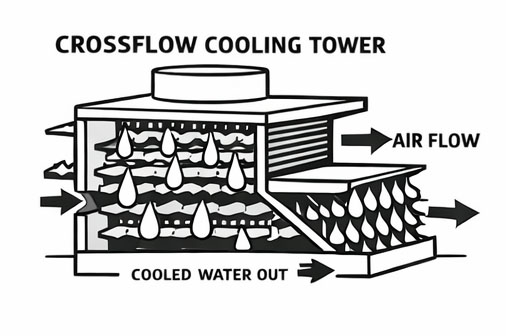
When no blockage has occurred, the cooling tower fill layer typically appears as a black plastic structure with a regular surface and unobstructed internal channels.Circulating water can fall evenly and continuously through the fill layer.The fill layer is the most critical heat-exchange zone inside the cooling tower; its function is to maximize the contact area between water and air to achieve effective heat dissipation.
If the circulating water entering the fill layer has poor quality and contains a large amount of suspended solids or impurities,these contaminants will, over time, gradually deposit and adhere to the fine internal channels of the fill.This causes channel narrowing or even complete blockage, and the heat transfer efficiency drops significantly.
The direct consequence is degraded cooling performance, continuously rising return-water temperature, and ultimately an adverse effect on the stable operation of the entire production system.
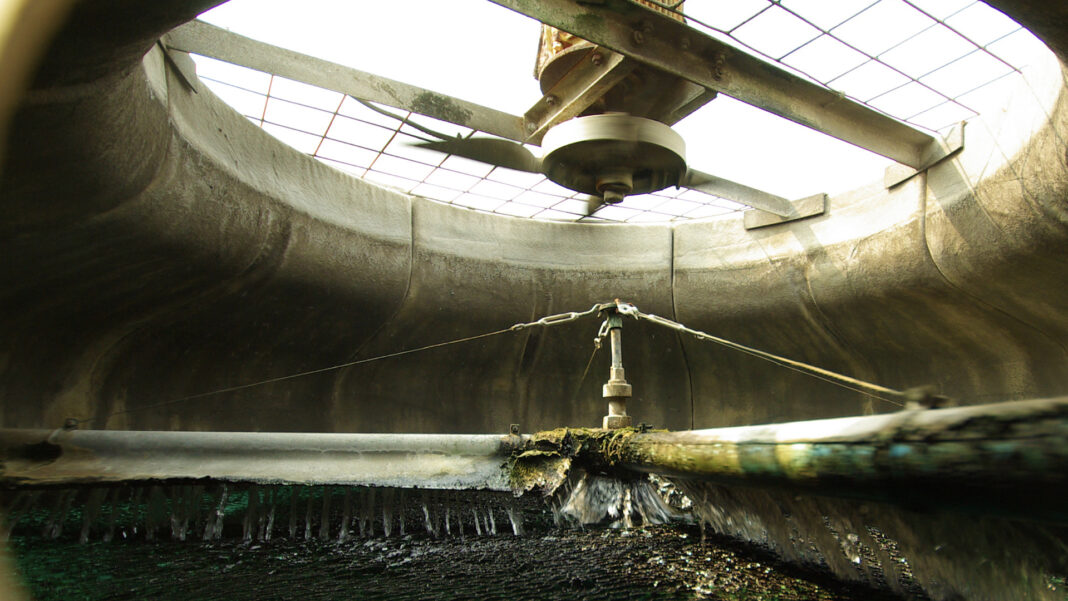
A Typical Case: Severe Blockage of the Fill Layer in a Short Time
The case we are discussing this time is a typical example in which the fill layer experienced severe blockage within a relatively short period.
Why Did the Fill Layer Become Blocked to This Extent?
Under normal design and operating conditions, cooling tower fill typically has a service life of about ten years or even longer.However, in this case the cooling tower had been in service for only about five years when the fill layer became heavily contaminated and completely blocked, rendering the cooling tower unusable.
The final assessment was that the fill had lost its cleanability and recoverability and had to be replaced entirely.
From on-site observations, the removed fill packs had already completely hardened; both the external surfaces and internal passages were covered with scale and deposits.The hardness was extremely high — to the point that one could step on it and feel like walking on a concrete floor.The degree of blockage far exceeded normal aging and was nearly equivalent to decades of accumulation under extreme operation.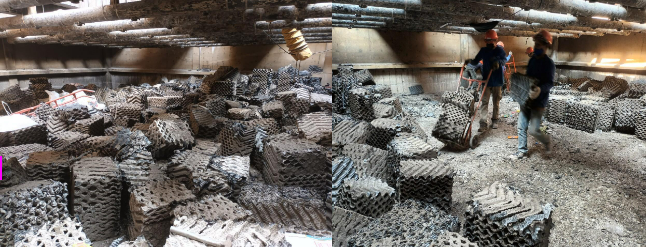
Difficulties in Removal and Repair
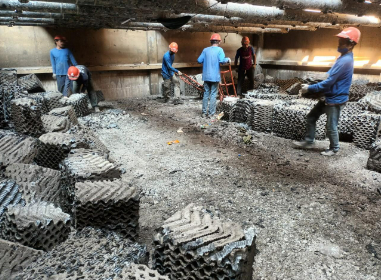
Because the fill had become severely adhered to the tower basin plate, conventional disassembly methods could not be applied.Maintenance work had to begin by carefully scraping the fill off the floor bit by bit, then cutting it into small pieces inside the cooling tower for removal.
Due to the confined space inside the tower, large cutting equipment could not be used.Maintenance personnel had to use hand saws to cut the material into sections and slowly carry the small pieces out of the tower.This was a highly challenging maintenance task: difficult, time-consuming, and labor-intensive.
Only Five Years in Service — Why Was the Contamination So Severe?
The Core Issue: Mismatch Between Fill Selection and Actual Operating Environment
The crux of the problem does not lie in the “service life” itself but in the mismatch between the chosen fill type and the actual operating environment.
Five years earlier, the cooling tower was specified with a composite fill resembling a mixed pattern of staggered slots and cross slots.This type of fill performs well in many conditions and has a wide applicability range.From a purely water-quality perspective the fill selection was technically reasonable — there was no obvious error on that basis alone.
However, the issue appears to be that the selection at the time may have considered only circulating-water quality and overlooked the plant environment where the tower was located.
The cooling tower served a cement plant.During cement production, large amounts of fine cement dust remain suspended in the ambient air for long periods.When the cooling tower operates, it continuously draws in surrounding air; these dust particles are carried into the tower and rapidly form high-hardness agglomerates upon contact with water.
Over time, cement dust repeatedly mixes with water, deposits, and hardens, gradually attaching to the fill surface and internal channels to form increasingly dense and rigid surface layers.Eventually the original plastic fill structure became almost entirely encapsulated by cement deposits; the actual working surface was no longer the designed fill but a “cement layer.”This condition differs fundamentally from ordinary scaling and is almost impossible to clean.
Cooling Tower Fill Selection Tips (Engineering Perspective)
In a cooling tower system, fill is not a “universal component”: whether the selected type is appropriate often directly determines subsequent operational stability and maintenance cost.In engineering practice, fill selection should at minimum consider the following aspects comprehensively:
1. Consider the Environment as Well as Water Quality
Many selections focus only on circulating-water indicators such as hardness, turbidity, or oil content.However, in actual operation a cooling tower is an “open system,” so the surrounding environment is equally crucial.In high-dust environments such as cement plants, steel mills, mines, and power plants, priority should be given to fill structures with strong anti-clogging capability and larger flow channels.Avoid choosing fills with overly complex or dense structures.
2. Prefer Practical Fill Structure Over Theoretical Heat Transfer Efficiency
Under laboratory conditions, complex-structured fills may show higher theoretical heat transfer efficiency, but on industrial sites stable long-term operation is often more important than peak efficiency.From an engineering standpoint, pay more attention to:
— Susceptibility to Fouling
Will the structure readily trap solids, dust, or biological growth?
— Ease of Cleaning
Can the fill be effectively cleaned or backwashed during maintenance windows?
— Tolerance for Operating While Soiled
Can the system tolerate some degree of fouling without immediate failure?
In high-contamination operating conditions, choosing a fill that is “harder to clog” is often more reasonable than choosing the theoretically “most efficient” option.
3. Material Durability and Maintainability
Fill materials should possess good anti-aging and anti-corrosion properties, and consideration must also be given to future maintenance and replacement difficulty.If a fill, once clogged, cannot be disassembled or cleaned, then no matter how long its theoretical lifespan, its practical value will be greatly diminished.
4. Match the Fill to the Overall Cooling Tower Design
Fill selection should be compatible with the cooling tower’s air volume, water flow distribution, and spray system design to avoid localized water concentration, dry zones, or dead zones that accelerate scaling and aging.
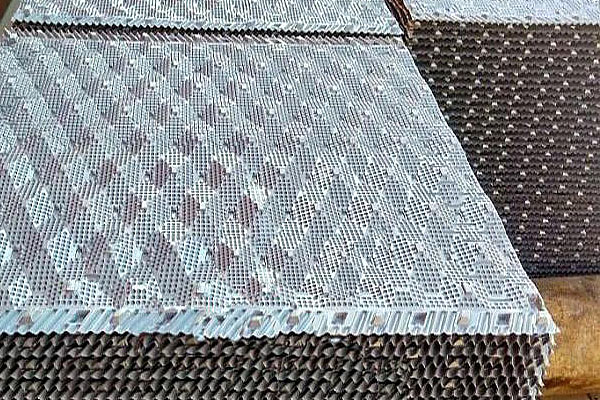
Daily Maintenance Points for Cooling Tower Fill
Rather than facing costly full replacement after only a few years, it is better to implement preventive maintenance during daily operation.Engineering experience indicates that fill maintenance should focus mainly on the following areas:
1. Regular Inspection of Fill Surface Condition
It is recommended to perform visual inspections of the fill surface during annual maintenance or shutdown windows, focusing on:
- Whether obvious scaling appears
- Whether there are hardened or compacted areas
- Whether local severe blockage zones exist
If abnormalities are found, they should be addressed early to prevent escalation.
2. Monitor the Air-Inlet Side and Upper Fill Layers
In high-dust environments, the areas that typically clog first are not the lower sections but the regions near the air inlet and the upper fill layers.These positions should be prioritized during inspections.
3. Conduct Appropriate Online or Offline Cleaning
For fills that have not yet fully hardened, appropriate water flushing, chemical cleaning, or physical removal can often extend service life.However, cleaning methods must be matched to the fill material and the type of deposit to avoid accelerating damage through improper procedures.
4. Control Circulating Water Quality
Maintaining a reasonable blowdown ratio and preventing prolonged elevated concentrations of suspended solids and solids in the circulating water is one of the fundamental measures to slow down fill blockage.
5. Timely Adjustment of Operating Parameters
Abnormal water distribution, excessively high spray density, or airflow imbalance can all accelerate fill contamination and scaling; these should be corrected promptly through operational adjustments.
Engineering Experience Summary
The reliable operation of a cooling tower system depends not only on the specifications and materials of the equipment itself,but also on whether the actual operating environment has been fully considered.
If the service provider has sufficient engineering experience and a sense of responsibility, they will comprehensively evaluate water quality, plant environment, dust conditions, maintenance cycles, and budget constraints during the proposal stage,and they will clearly communicate the advantages, disadvantages, and potential risks of different selection options to the owner when necessary.
Even when budget constraints require configuration reduction, transparency and controllable risk should be ensured in the early stages of the project.This allows the user to clearly understand the system’s operational boundaries and avoid problems that become irrecoverable only after several years of operation.
Truly professional and trustworthy service is often reflected in these early, seemingly minor but long-term critical engineering judgments.
2026-3-12
2026-1-30
Cooling Tower Fill Maintenance...
2025-12-22
Comparison Guide: Counterflow ...
2025-12-10