We love film fill cooling tower media. It’s efficient, compact, and affordable. But let’s be real—it has a weakness. It hates dirty water. If you are operating in an environment with dust, oil, fibers, or high biological content, putting standard film fill in your tower is like putting a banana in a tailpipe. It’s going to clog.
So, what do you do when you need cooling but your water isn't crystal clear? Let's talk about Splash Grid Fill and Low-Fouling Corrugated Fill designs.
The Problem with Standard Film Fill in Dirty Water
Standard Cooling Tower Media often has small flutes (12mm to 19mm) with complex textures to mix air and water. When water contains suspended solids, these solids get trapped in the cross-corrugations. Once a little bit gets stuck, it grows. Soon, calcification sets in, and entire blocks become solid rocks. I've seen fills weigh 10x their original weight due to sludge!
Solution 1: Low-Fouling / Vertical Flow Film Fill
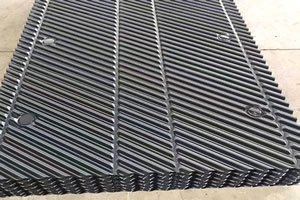
If your water is "moderately" dirty, you don't necessarily need to abandon film fill. You need vertical flow fill. unlike the cross-corrugated designs used in standard Counterflow Film Fill, vertical flow fills have straight channels. This allows the water to flush debris down into the basin rather than catching it. We offer specific large-flute designs (roughly 25mm to 30mm) for this exact purpose.
Solution 2: Splash Grid Fill (The Ultimate Heavy Duty Option)
For the truly dirty jobs—mining, sugar processing, heavy chemical—you need Splash Grid Fill.
Structure: It looks like a series of open grids or slats.
How it works: Instead of forming a film, the water falls, hits a grid bar, splashes, falls again, and hits another bar.
Why it works: There are no tight channels to clog. You could practically throw a handful of mud through it, and it would pass through.
Material: Usually made of PP for durability.
Comparing Efficiency: Film vs. Splash
Here is the trade-off. Splash Grid Fill is less efficient per cubic meter than film fill. This means for the same cooling duty, a splash fill tower needs to be larger. However, in dirty applications, a film fill tower will lose 50** of its efficiency in 6 months due to clogging, while a splash fill tower will run at 100** efficiency for 20 years. Which one is truly more efficient in the long run?
Retrofitting: Changing from Film to Splash?
If you are tired of replacing your Cooling Fill every two years because of clogging, we can discuss a retrofit. Note that since Splash fill is less efficient, we might need to look at your fan power or water flow rates to compensate. It's an engineering calculation, but it often pays off in maintenance savings.
Don't Forget the Air Inlet
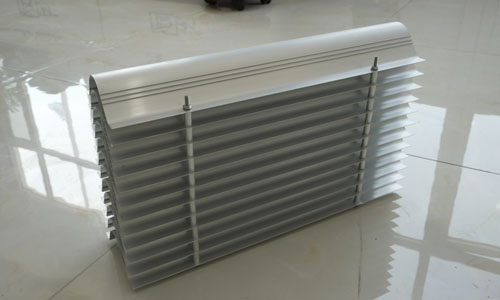
Sometimes the dirt comes from the air, not the process. If you are in a dusty desert environment, your Cooling Tower Air Inlet Louvers are your first line of defense. High-quality cellular louvers can block sunlight (stopping algae) and prevent larger debris from being sucked into the tower basin.
Buying Tips for Dirty Water Fills
- Ask for "flute size": If they offer you 12mm for dirty water, run away. You need 25mm+ or splash grids.
- Material thickness: Dirty water fills often need high-pressure cleaning. Ensure the PVC cooling tower fill or PP sheets are thick enough to withstand a power washer.
Summary
Don't fight your water quality. Work with it. If you have clean water, use high-efficiency film fill. If you have dirty water, embrace the rugged reliability of Splash Grid. It’s about choosing the right tool for the job.
Is your current fill clogging up?
Send us a photo of your clogged fill. We can analyze the type of fouling (biological, scaling, or sediment) and recommend the perfect "Low-Fouling" or "Splash" solution to stop the headache.
Stop the clogging today.