Let’s be honest for a second. We often spend a lot of time worrying about the fans, the motors, and the pumps in our cooling systems. But if the Cooling tower Fill isn't doing its job, none of that matters. As someone who has spent years in this industry, working with clients from hot, humid Jakarta to the dry heat of Dubai, I can tell you: the fill is the absolute heart of your cooling tower. If the heart is weak, the whole system suffers.
Today, I want to walk you through exactly what you need to know about selecting, maintaining, and understanding your tower fill, just like I would if we were sitting down for a coffee discussing your plant's efficiency.
What Exactly is Cooling Tower Fill? (And Why Should You Care?)
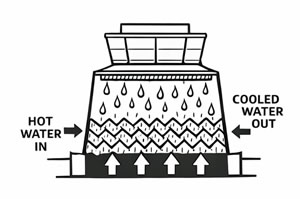
In simple terms, the fill is the medium used to increase the surface area of the water. The more surface area, the more contact with air, and the better the evaporation. Better evaporation means better cooling. It’s that simple. Whether you call it Cooling Tower Media or packing, its job is to spread that water out into a thin film.
If you choose the wrong type, you might face clogging, reduced thermal performance, or even structural collapse under the weight of scale. I've seen factory managers scratching their heads wondering why their water temp is 3°C higher than it should be—9 times out of 10, it's the fill.
Categorizing by Cooling Tower Type: Crossflow vs. Counterflow
Before you buy anything, look at your tower. The airflow direction dictates everything.
For Counterflow Towers
In these systems, air moves vertically up while water falls down. You need a fill that allows air to pass through without too much resistance (pressure drop) but keeps the water in contact with the air as long as possible. We typically use Counterflow Film Fill here. The flute geometry is designed specifically to balance airflow and water hold-up.
For Crossflow Towers
Here, air moves horizontally across the falling water. These fills usually have integral louvers and drift eliminators built right into the sheets. If you are running this type of system, you need specialized Crossflow Film Fill. Don't try to mix and match; using a counterflow fill in a crossflow tower is a recipe for disaster in terms of water distribution.
Material Matters: PVC vs. PP
This is a question I get asked almost every day: "Should I use PVC or PP?"
PVC (Polyvinyl Chloride)
For 90** of standard applications, PVC cooling tower fill is the champion. It’s cost-effective, durable, and has excellent self-extinguishing properties. If your water temperature stays under 55°C (130°F), PVC is your best friend.
PP (Polypropylene)
However, if you are in an industry where the water gets really hot (above 60°C) or the water quality is aggressive, you need to step up to PP Cooling Tower Fill. I had a client in Korea with a high-temp industrial process who tried to save money with standard PVC—the blocks literally warped and melted. Don't make that mistake. PP is tougher and handles heat much better.
Fill Types and Structure: Film vs. Splash
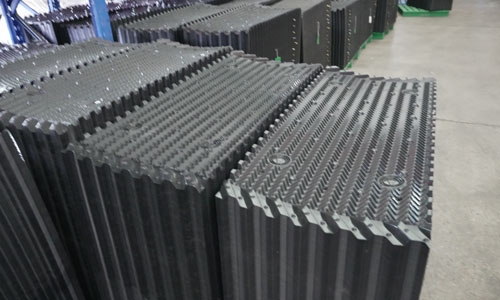
Most modern towers use film fill cooling tower media. These are sheets (usually corrugated) glued or mechanically bonded together to form blocks. They offer the highest efficiency because they create a massive surface area in a small volume.
But, if you have very dirty water—I'm talking about water with lots of suspended solids, oils, or fibers—film fill will clog. Fast. In those cases, I recommend Splash Grid Fill. It doesn't use a film; it breaks water droplets by splashing them over grid bars. It’s less efficient per cubic meter, but it won't clog.
Performance, Efficiency, and "Corrugated Fill"
The magic is in the corrugation. The "flute size" (the size of the channels) determines efficiency.
- Small Flutes (12mm - 15mm): Highest efficiency, but requires very clean water.
- Large Flutes (19mm - 25mm+): Slightly less efficiency, but much more forgiving of dirty water.
Sizing and Customization: One Size Does Not Fit All
I cannot stress this enough: send us your exact dimensions. While there are standard block sizes (like 1200mm x 300mm x 300mm), most towers need custom cuts. We offer "Kit" forms (sheets you assemble on-site to save shipping volume to Southeast Asia) or pre-glued blocks.
If you are retrofitting an older tower, we might need to cut the Cooling Fill to fit around beams or columns. Always measure twice!
Buying Tips from an Engineer
- Sheet Thickness: Ask the supplier about the sheet thickness after forming. Some cheap suppliers use very thin sheets that crumble after a year. We ensure structural integrity.
- Bonding Method: Glue tips matter. If the glue points are weak, the block falls apart.
- Edges: Look for reinforced edges if you have high water impact loads.
Daily Maintenance and Troubleshooting
Even the best Film Fill needs love.
Inspect regularly: Look for scale build-up. Calcium carbonate is the enemy.
Watch the weight: If a block feels incredibly heavy, it’s full of scale or sludge.
Check Air Inlets: Ensure your Cooling Tower Air Inlet Louvers are not blocked. Blocked louvers mean uneven airflow through the fill.
Summary
Choosing the right fill isn't just about buying plastic blocks; it's about understanding your water quality, your temperatures, and your efficiency goals. Whether you need a high-efficiency Counterflow block or a dirty-water Splash Grid, getting it right saves you energy and headaches down the road.
Still not sure which fill fits your tower?
I know this can be technical. If you are confused about the flute sizes, materials, or just want a second opinion on your project, let me help you directly. You can send me your tower drawings, photos of your old fill, or just a simple sketch.
Let's get your cooling tower running at 100** efficiency again.