
Cooling Tower Fill Design Calculation: Engineering Logic Behind Thermal Performance
In industrial cooling systems, cooling tower fill is often treated as a standard component. However, from an engineering perspective, fill design directly determines heat exchange efficiency, airflow resistance, and long-term system stability.
This article explains how cooling tower fill performance is calculated, how design parameters affect efficiency, and how engineers can make better decisions based on real operating conditions rather than catalogue data.
1. Understanding Heat Transfer Mechanism Inside Cooling Tower Fill
Cooling towers operate based on evaporative cooling. Heat is removed through a combination of:
- Sensible heat transfer
- Latent heat transfer through evaporation
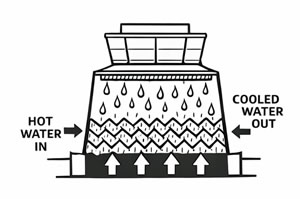
The role of cooling tower fill media is to maximize the contact area between water and air, allowing efficient heat and mass transfer.
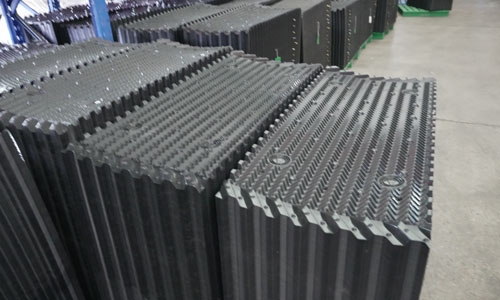
In film fill systems, water spreads into thin layers over structured surfaces, increasing exposure time and surface area.
2. Merkel Equation and Its Application
The Merkel equation is the most widely used model for cooling tower performance calculation. It integrates heat and mass transfer into a single relationship.
The equation depends on:
- Air enthalpy difference
- Water temperature profile
- Mass transfer coefficient
Cooling tower fill design affects the Merkel number, which represents overall heat transfer capability.
3. Key Design Parameters of Cooling Tower Fill
3.1 Specific Surface Area
Higher surface area improves heat transfer but increases resistance to airflow.
3.2 Flute Spacing
Typical film fill spacing:
- 12mm (high efficiency, higher fouling risk)
- 19mm (balanced performance)
- 27mm+ (lower efficiency, better for dirty water)
Selecting the wrong spacing can lead to rapid performance decline in high scaling environments.
3.3 Material Selection
PVC cooling tower fill is suitable for most applications below 60°C.High temperature systems require modified PVC or PP material.
4. Airflow and Pressure Drop Consideration
Increasing surface area also increases airflow resistance.
Fan performance must match fill design. Otherwise:
- Airflow decreases
- Heat transfer efficiency drops
- Energy consumption increases
This is why cooling tower fill design must always be evaluated together with fan capacity.
5. Water Distribution Impact
Even the best fill design fails without uniform water distribution.
Uneven spray leads to:
- Dry zones
- Reduced effective area
- Localized overheating
6. Practical Engineering Mistakes
- Choosing smallest flute spacing without water analysis
- Ignoring fan capacity when upgrading fill
- Using standard PVC in high-temperature systems
- Overlooking maintenance accessibility
7. Engineering Conclusion
Cooling tower fill design is not a catalogue selection — it is an engineering decision.
Proper evaluation of heat transfer, airflow resistance, and operating conditions ensures long-term performance stability and energy efficiency.
Need help calculating your cooling tower performance?
Send us your operating temperature, flow rate, and tower type. We can help evaluate the right cooling tower fill design for your system.
2026-3-6
2025-12-13