

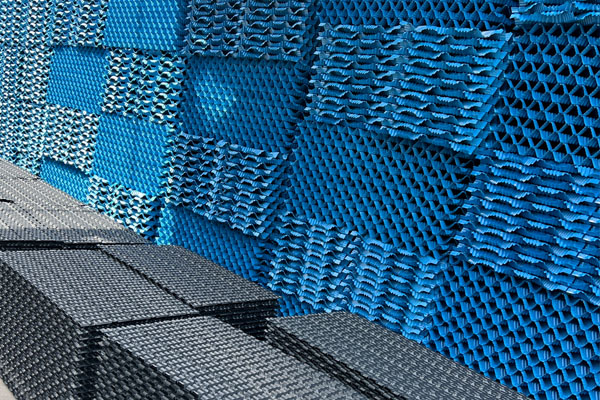
Cooling Tower Film Fill Media
Practical Heat Transfer Media for Industrial Cooling Towers
What Cooling Tower Film Fill Media Really Does
In a cooling tower, film fill media is where most of the heat exchange actually happens. No matter how big the fan is or how strong the structure looks, if the fill is not doing its job, the cooling tower will never perform the way it should.
Simply put, cooling tower film fill media works by spreading hot circulating water into a thin, even film over a large surface area. When air passes through the fill, heat is taken away mainly through evaporation. The more stable and uniform that water film is, the better the cooling effect.
From real project experience, film fill almost always gives better efficiency than splash fill, as long as the water quality is reasonably controlled. That’s why today most industrial cooling towers, especially counterflow and crossflow designs, rely on film fill as the core internal component.
How Film Fill Media Works in Daily Operation
In actual operation, water from the distribution system flows down over the fill sheets. The shape of the sheets — usually corrugated or fluted — forces the water to spread out instead of forming streams. At the same time, air moves through the fill pack, either from bottom to top (counterflow) or from side to side (crossflow).
What matters in real life is not just theory, but how stable this process stays after months or years of operation. Good cooling tower film fill media keeps the water evenly distributed, avoids dry spots, and does not collapse or deform under continuous load. When these basic conditions are met, the cooling tower runs more steadily and consumes less energy.
PVC and PP Film Fill – What Engineers Actually Choose
Most film fill media on the market is made from PVC or PP, and both have their place.
PVC film fill is widely used because it works well in most standard conditions. It is cost-effective, easy to form, and provides good water wetting. For HVAC systems, general industrial cooling, and clean circulating water, PVC film fill is usually enough and performs reliably.
PP film fill, on the other hand, is chosen when conditions are tougher. Higher water temperature, higher chemical concentration, or more aggressive operating environments are common reasons to go with PP. PP handles heat and chemicals better and usually lasts longer in these situations, even though the initial cost is higher.
In practice, choosing between PVC and PP is not about which one is “better”, but which one matches the actual operating conditions of the cooling tower.
Where Cooling Tower Film Fill Media Is Commonly Used
From what we see on site, cooling tower film fill media is used in almost every major industrial cooling application:
Power plants and power generation facilities
Petrochemical and refinery cooling towers
HVAC systems for large buildings and district cooling
Steel plants and heavy manufacturing
Industrial process cooling systems
In all these applications, the goal is the same: stable cooling performance, reasonable pressure drop, and a fill structure that can run for years without constant maintenance.
Why Film Fill Is Still the First Choice
After working with different types of fill media, it’s clear why film fill remains the first choice for most projects:
Higher cooling efficiency with less fill height
Better use of airflow and water distribution
More predictable performance in long-term operation
Flexible designs for different tower sizes and layouts
Easy replacement for existing cooling tower upgrades
When properly selected and installed, cooling tower film fill media helps reduce operating costs and improves the overall reliability of the cooling system.
Contact Us
If you are selecting cooling tower film fill media for a new project or replacing existing fill, it’s always better to talk with someone who understands real operating conditions, not just catalog data.
We can help you:
Choose the right PVC or PP film fill based on water quality and temperature
Match fill design to your cooling tower type and operating load
Provide practical recommendations from real project experience
Supply stable, quality-controlled film fill media for long-term use
Contact us anytime to discuss your cooling tower project, request technical details, or get a quotation that actually fits your application.


