
Cooling Tower Fill Performance Degradation: Data-Based Analysis and Efficiency Modeling
Introduction: Understanding Performance Decline Over Time
Cooling Tower Fill is the core heat exchange medium inside any evaporative cooling system. While initial thermal performance may meet design specifications, real-world operation introduces gradual degradation mechanisms that impact efficiency.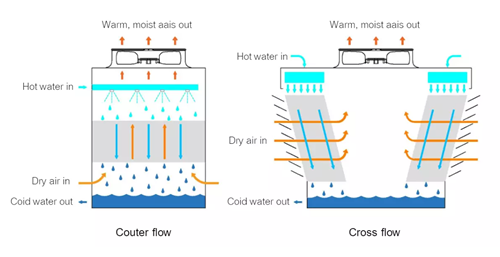
Unlike mechanical equipment that fails suddenly, Cooling Tower Fill typically loses efficiency progressively. This decline may go unnoticed until energy consumption increases or production cooling capacity becomes insufficient.
This article examines performance degradation using engineering modeling logic, helping industrial operators evaluate efficiency loss quantitatively rather than subjectively.
Baseline Thermal Performance: Initial Design Conditions
Under clean and stable operating conditions, Film Fill Cooling Tower structures provide high surface area for air-water contact. The thermal performance depends on:
- Effective wetted surface area
- Air velocity distribution
- Water flow uniformity
- Material stability
For example, properly installed Counterflow Film Fill systems maximize vertical air-water interaction, achieving high heat transfer coefficients.
However, baseline performance assumes optimal water chemistry and structural geometry.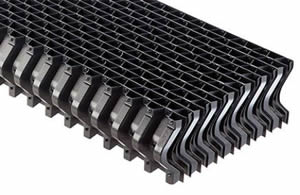
Degradation Mechanism 1: Surface Area Reduction
Mineral scaling gradually covers wetted surfaces. Even thin calcium carbonate layers reduce effective heat exchange area.
In PVC cooling tower fill systems, narrow corrugation spacing accelerates blockage when water hardness exceeds treatment limits.
Data from industrial case studies shows that 10–15** surface blockage can result in 2–4** cooling capacity reduction.
Degradation Mechanism 2: Increased Airflow Resistance
When channels become partially blocked, static pressure rises. Fans must operate at higher load to maintain airflow.
Energy modeling indicates that a 5** increase in airflow resistance may increase fan energy consumption by 8–12** depending on system configuration.
Systems using PVC Cooling Tower Fill in high-dust environments may experience faster resistance growth compared to more open-structure designs.
Degradation Mechanism 3: Thermal Deformation and Channel Instability
Continuous exposure to elevated water temperature may distort sheet geometry. Once corrugation angle shifts, water distribution changes and air velocity patterns become uneven.
Industrial systems operating above 55°C continuous inlet temperature often transition toward PP Cooling Tower Fill for improved dimensional stability.
Efficiency Modeling: Estimating Performance Decline
Performance modeling can be simplified into three measurable parameters:
- Approach temperature increase
- Fan power consumption trend
- Water temperature differential reduction
If approach temperature increases gradually over several months without load change, Cooling Tower Media degradation is a probable factor.
For example:
- Initial approach: 4°C
- After 3 years: 6°C
- No change in ambient condition
This 2°C difference may indicate 10–20** effective performance loss.
Industrial Energy Impact Calculation
In large-scale industrial cooling towers (e.g., 10 MW thermal load), even minor efficiency reduction significantly impacts annual energy cost.
Assuming fan system power of 200 kW operating 8,000 hours per year:
- 5** efficiency loss → increased power demand
- Estimated additional energy: 80,000 kWh annually
Over 5 years, degraded Cooling Tower Fill may indirectly generate substantial operational cost beyond replacement expense.
Comparing Film Fill and Splash Fill Degradation Behavior
Film Fill Cooling Tower systems offer superior initial efficiency but are more sensitive to scaling.
In contrast, Splash Grid Fill structures exhibit lower theoretical heat transfer performance but slower degradation in dirty water environments.
Therefore, degradation rate is not universal. It depends on operating conditions.
When Does Degradation Become Economically Significant?
Replacement decision should consider:
- Energy penalty exceeding replacement cost
- Frequent cleaning downtime
- Structural instability
- Rising maintenance labor expense
In many cases, replacing Cooling Tower Fill proactively before catastrophic failure yields better economic outcome.
Engineering Strategy for Monitoring Performance
Recommended monitoring framework:
- Quarterly approach temperature tracking
- Fan motor current monitoring
- Visual inspection schedule
- Annual water chemistry review
Cooling Tower Fill degradation is measurable. Quantitative tracking transforms reactive maintenance into predictive management.
Conclusion: Data-Driven Fill Management Improves Industrial Stability
Cooling Tower Fill performance decline follows identifiable patterns. By combining temperature data, airflow modeling, and energy consumption trends, engineers can estimate degradation accurately.
Structured evaluation ensures replacement decisions are based on lifecycle economics rather than emergency failure.
Want to estimate the efficiency impact of your current Cooling Tower Fill?
Provide your approach temperature trend, operating hours, and water analysis. Our engineering team can help evaluate performance degradation and recommend optimized solutions.
Contact Us
2026-3-12
2026-1-30
Cooling Tower Fill Maintenance...
2025-12-22
Comparison Guide: Counterflow ...
2025-12-10