
Cooling Tower Fill Failure Analysis: Root Causes and Prevention Strategies for Industrial Systems
Introduction: Why Cooling Tower Fill Failure Is Rarely Sudden
Cooling Tower Fill does not usually fail overnight. In most industrial cooling systems, performance degradation happens gradually. Thermal efficiency declines, fan load increases, and approach temperature widens before visible structural damage appears.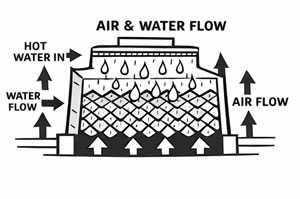
Understanding Cooling Tower Fill failure requires analysis from multiple engineering dimensions:
- Thermal stress
- Water chemistry
- Mechanical integrity
- Airflow dynamics
- Maintenance practices
This article provides a structured failure analysis framework designed for engineers managing global industrial cooling systems.
Failure Mode 1: Thermal Deformation
Root Cause
PVC cooling tower fill operates effectively within its thermal tolerance range. When continuous inlet water temperature exceeds material limits (often 50–55°C), polymer softening begins.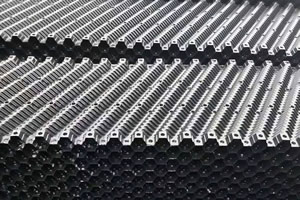
Long-term exposure results in:
- Sheet distortion
- Corrugation collapse
- Reduced channel spacing
- Increased airflow resistance
Industrial Risk Scenario
In petrochemical or power plant condenser systems, elevated discharge temperatures can expose Film Fill Cooling Tower structures to continuous thermal stress.
Prevention Strategy
- Confirm maximum continuous temperature, not design peak
- Upgrade to PP Cooling Tower Fill when necessary
- Monitor seasonal load variations
Failure Mode 2: Scaling and Mineral Deposition
Root Cause
High calcium hardness, silica concentration, and elevated TDS accelerate scale formation. Narrow-pitch Film Fill structures are particularly sensitive to mineral buildup.
Scale accumulation leads to:
- Blocked water channels
- Increased static pressure
- Uneven wetting surface
- Reduced heat transfer area
Global Regions at Higher Risk
Middle East, Africa, and parts of Southeast Asia often experience high-hardness water conditions, increasing scaling risk.
Prevention Strategy
- Water treatment optimization
- Regular inspection schedule
- Consider Splash Grid Fill for high-solid environments
Failure Mode 3: Biological Fouling
Biofilm formation reduces effective Cooling Tower Media surface area. Algae growth blocks airflow channels and alters water distribution patterns.
In warm climates, biological activity accelerates significantly.
Prevention Strategy
- Controlled biocide dosing
- Routine cleaning intervals
- Monitoring microbial growth levels
Failure Mode 4: Mechanical Sagging and Structural Fatigue
Improper support beam spacing or long-term vibration can cause sagging in Film Fill blocks.
Mechanical stress increases under:
- High airflow velocity
- Heavy scale load
- Thermal expansion cycles
Prevention Strategy
- Verify structural support design
- Select appropriate sheet thickness
- Conduct periodic visual inspection
Failure Mode 5: UV Degradation
Open rooftop cooling towers in high-UV regions expose PVC cooling tower fill to radiation stress.
Without proper UV stabilizers, brittleness may develop over time.
Failure Detection Indicators
Early detection prevents major operational loss. Warning signs include:
- Increasing approach temperature
- Higher fan energy consumption
- Uneven water distribution patterns
- Visible sheet cracking or warping
System-Level Consequences of Cooling Tower Fill Failure
When Cooling Tower Fill efficiency declines:
- Compressor load increases
- Energy cost rises
- Production throughput may drop
- Equipment overheating risk increases
In large industrial plants, minor efficiency loss can translate into significant annual operational expense.
Engineering Prevention Framework
Preventive strategy should integrate:
- Correct material selection (PVC vs PP)
- Fill structure matched to water quality
- Proper airflow design
- Maintenance discipline
- Lifecycle evaluation planning
Conclusion: Cooling Tower Fill Failure Is Predictable
Most Cooling Tower Fill failures are not material defects. They are consequences of mismatched operating conditions.
Applying structured engineering evaluation dramatically extends service life and protects system efficiency.
- PVC Cooling Tower Fill
- PP Cooling Tower Fill
- Splash Grid Fill
- Counterflow Film Fill
Experiencing performance decline in your cooling tower?
Share your operating conditions and inspection data. Our engineering team can help analyze potential Cooling Tower Fill failure risks and recommend preventive solutions.
Contact Us
2026-3-6
2025-12-13