

Cooling Tower Fill Replacement Guide: Engineering Evaluation, Failure Diagnosis, Retrofit Strategy & ROI Analysis
If you are evaluating a cooling tower fill replacement project, the first question should not be price — it should be performance recovery potential.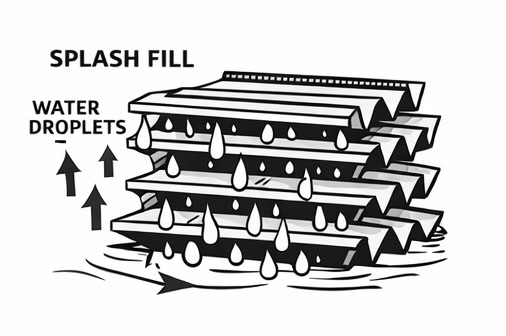
Before discussing materials or models, it is important to understand how the existing cooling tower fill system works inside your tower and how degradation affects real heat transfer efficiency.
This guide is written for engineers, EPC contractors, and maintenance managers who want a technically sound, globally applicable replacement strategy — not just a supplier quotation.
PART 1 – Engineering Evaluation & Failure Diagnosis
1. When Does Cooling Tower Fill Actually Need Replacement?
Many operators replace fill too early. Others wait too long and sacrifice energy efficiency.Replacement is technically justified when one or more of the following conditions are met:
1.1 Thermal Performance Loss Greater Than 15**
- Approach temperature increases
- Cold water temperature rises
- Fan operates longer under same load
When performance drops, effective heat transfer surface area inside the cooling tower fillis typically reduced due to fouling, deformation, or airflow obstruction.
1.2 Structural Deformation
- Sagging sheets
- Collapsed air channels
- Uneven water distribution
- Local dry zones
Continuous operation at elevated temperature or poor material selection can cause PVC sheets to soften and deform, especially in crossflow towers.
1.3 Excessive Pressure Drop
If static pressure drop increases beyond 20**, airflow resistance may be caused by clogged or collapsed fill media.
2. Root Causes of Cooling Tower Fill Failure
2.1 Scaling and Mineral Deposition
High TDS water leads to mineral buildup inside film channels. Narrow flute spacing such as 19mm structures are more sensitive to scaling in heavy industrial environments.
2.2 Biological Fouling
Algae, slime, and biofilm reduce wetted surface area and airflow passage. This is common in warm and humid regions.
2.3 Thermal Softening
Standard PVC is generally suitable for continuous operation up to 55–60°C.Higher temperature systems may require modified PVC or polypropylene fill.
2.4 Mechanical Aging
Long-term UV exposure and vibration may cause brittleness, cracking, and sheet fragmentation.
PART 2 – Replacement Engineering & Retrofit Strategy
3. Film Fill vs Splash Fill: Should You Change Type?
3.1 Film Fill (High Efficiency)
- Suitable for treated or clean water
- Higher heat transfer coefficient
- Compact tower footprint
Film type cooling tower fill maximizes surface area by forming thin water films across structured PVC sheets.
3.2 Splash Fill (Heavy-Duty Application)
- Better resistance to clogging
- Suitable for dirty or high-solids water
- Lower fouling sensitivity
Splash fill is commonly selected for steel plants, mining sites, and process water systems with unstable quality.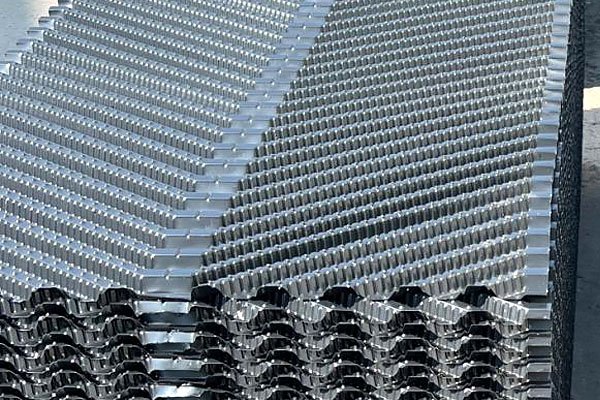
4. Engineering Steps for Replacement
Step 1 – Confirm Original Tower Configuration
- Crossflow or counterflow
- Fill height
- Support beam spacing
- Air inlet configuration
Step 2 – Verify Material Compatibility
PVC: Cost-effective, moderate temperature resistance. PP: Higher temperature tolerance and chemical resistance.
Step 3 – Modular Block Planning
Segmented blocks allow faster installation, easier maintenance, and reduced downtime during retrofit.
Step 4 – Airflow Recalculation
Changing flute spacing affects pressure drop and fan energy consumption. Always evaluate airflow compatibility before finalizing structure.
PART 3 – Economic & Global Considerations
5. ROI of Cooling Tower Fill Replacement
5.1 Energy Savings
Improved heat exchange reduces fan runtime, pump load, and chiller energy consumption. Even a 1°C reduction in cold water temperature can significantly improve compressor efficiency.
5.2 Downtime Optimization
Planned modular replacement minimizes shutdown time and protects production continuity.
5.3 Service Life Extension
- 5–8 years for standard PVC
- 8–12 years for high-grade material
6. Regional Engineering Considerations
Middle East
High mineral content and elevated temperatures require larger flute spacing and higher temperature-resistant materials.
Southeast Asia
Biological growth requires smooth-surface design and proper water treatment monitoring.
Industrial Europe
Chemical exposure and strict efficiency standards demand optimized L/G ratio and performance verification testing.
Conclusion – Replace Strategically, Not Emotionally
Cooling tower fill replacement is not simply a purchase — it is a performance optimization project.Correct engineering evaluation restores heat exchange efficiency, reduces energy consumption, and extends system lifespan.
For crossflow or counterflow towers, PVC or PP material selection, and modular retrofit supply, a structured technical evaluation ensures long-term operational stability.