

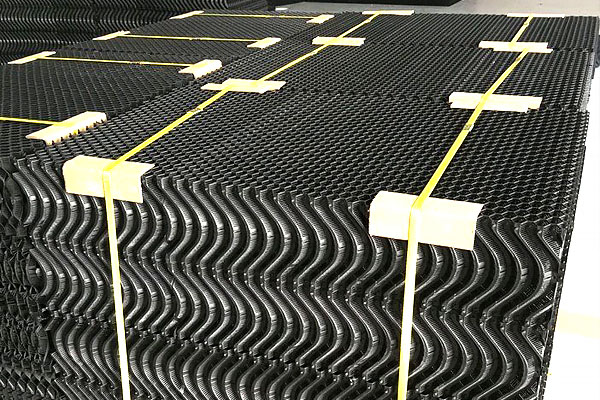
What Is PVC Cooling Tower Fill and Why It Still Dominates the Market
If you’ve worked with cooling towers long enough, you’ll notice one thing: no matter how many new materials come and go, PVC Cooling Tower Fill is still the most widely used solution worldwide.From Southeast Asia to the Middle East and even parts of Japan and Korea, PVC fill remains the go-to choice for balance — cost, performance, and availability.
In simple terms, Cooling Tower Fill (also called Cooling Tower Media or Tower Fill) is the heart of the heat exchange process. Its job is to maximize contact between water and air. The better this contact, the more heat you remove with the same airflow and fan power.
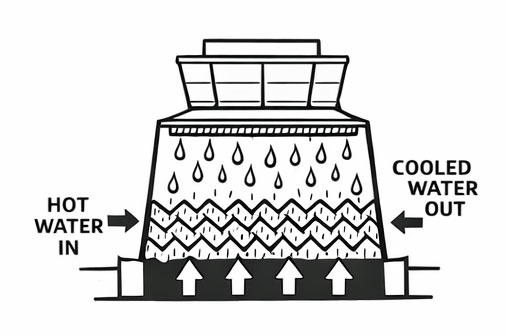
Cooling Tower Types and How Fill Selection Changes
Counterflow Cooling Towers
In counterflow towers, air moves upward while hot water flows downward. This design needs fill with good structural strength and efficient water spreading.That’s why film fill cooling tower designs are extremely common here.
If you’re running a counterflow system, you’ll usually be comparing:Counterflow Film Fill and standard PVC corrugated fill.
Crossflow Cooling Towers
Crossflow towers rely on gravity-fed hot water and horizontal airflow. Here, uniform water distribution matters even more.PVC Corrugated Fill with wider flute spacing is often preferred to reduce clogging.
For this type, we often recommend:Crossflow Film Fill.
Splash Type Cooling Towers
Not every site has clean water. In many industrial plants across Southeast Asia, water contains oil, scale, or suspended solids.Film fill can clog quickly under these conditions.
In these cases, a splash solution such asSplash Grid Fillcan outperform film fill over the long term.
Materials Used in Cooling Tower Fill
PVC Cooling Tower Fill
PVC is the most common material because it offers:
- Good temperature resistance for normal HVAC and industrial cooling
- Stable shape under continuous water flow
- Excellent cost-performance ratio
You can view our dedicated PVC product here:PVC Cooling Tower Fill.
PP Cooling Tower Fill
When water temperature is higher or chemical resistance is required, PP becomes a better option.PP fill is more flexible and handles higher operating temperatures.
Reference:PP Cooling Tower Fill.
Fill Structure, Flute Design, and Water Distribution
Film Fill Structure
Film fill works by spreading water into thin layers across corrugated sheets.This creates a massive surface area, improving heat transfer efficiency.Keywords you may see include Film Fill, Cooling Fill, or Cooling Tower Media.
Flute Angle and Spacing
Smaller flute spacing means higher efficiency — but also higher clogging risk.For cleaner water systems, tighter flute spacing improves thermal performance.For dirtier water, wider spacing improves long-term reliability.
Performance and Thermal Efficiency
Good PVC film fill can increase cooling efficiency by 10–25** compared to aged or damaged fill.That translates directly into:
- Lower outlet water temperature
- Reduced fan runtime
- Lower overall energy cost
Standard Sizes vs Customized Cooling Tower Fill
Standard Dimensions
Most PVC fill is supplied in blocks with standard heights (e.g. 300mm, 600mm).This keeps cost down and speeds up delivery.
Customized Solutions
If you’re replacing old fill in an existing tower, custom sizing often saves installation time.We frequently customize flute height, block size, and even material thickness.
Installation and Daily Maintenance Tips
Installation Advice
- Ensure proper support grids are level
- Avoid excessive compression of fill blocks
- Check water distribution before full operation
Routine Maintenance
Regular inspection helps extend fill life:
- Check for scale buildup every 6–12 months
- Clean clogged areas early
- Inspect drift eliminators and louvers together
Related products often replaced together include:Drift Eliminators andCooling Tower Air Inlet Louvers.
Material Comparison: PVC vs PP Cooling Tower Fill
| Item | PVC Fill | PP Fill |
|---|---|---|
| Cost | Lower | Higher |
| Temperature Resistance | Moderate | Higher |
| Application | HVAC, standard industry | High-temp or chemical systems |
Final Thoughts from an Engineer’s Perspective
PVC Cooling Tower Fill is not “cheap plastic” — when properly selected, it’s a proven engineering component.The key is matching water quality, tower type, and operating conditions.Most performance issues we see come from mismatched fill, not from the material itself.
Need Help Choosing the Right Cooling Tower Fill?
If you’re unsure which fill type fits your system, or if you already have drawings, photos, or samples,feel free to send them to us.
Our engineers review your case and recommend the most practical solution — not just the most expensive one.


