

Steel manufacturing facilities depend on reliable cooling water to protect production equipment, control process temperatures, and maintain stable operating conditions. From blast furnaces and electric arc furnaces to continuous casting machines and rolling mills, different production stages generate substantial heat and require different cooling arrangements. Cooling tower fill for steel manufacturing must therefore be evaluated according to the specific water circulation system, process requirements, and operating environment of each facility.
Unlike a general industrial cooling application, a steel plant may operate several interconnected cooling circuits with different water quality requirements. Understanding where cooling towers are used within these systems is essential before evaluating fill applications.
Cooling Tower Applications Across Steel Production Processes
Steel manufacturing involves both direct-contact and indirect cooling applications. Cooling towers commonly serve recirculating water systems that need to reject heat before returning water to production equipment or heat exchangers.
Blast Furnace and Steelmaking Operations
Blast furnaces, basic oxygen furnaces (BOF), and electric arc furnaces (EAF) use cooling water for equipment such as furnace panels, hoods, lances, and associated auxiliary systems. Depending on the plant design, these applications may use separate closed or semi-closed circuits with heat exchangers and cooling towers.
For these systems, cooling tower operation supports the removal of heat from the secondary cooling-water circuit. Engineers should understand the relationship between the equipment cooling loop, heat exchanger capacity, circulating water flow, and cooling tower performance. The actual arrangement varies between facilities and should be confirmed from process and equipment documentation.
Continuous Casting Processes
Continuous casting cooling systems require controlled water circulation for mold cooling, machine equipment cooling, and secondary spray cooling. These functions do not necessarily share the same water circuit.
Mold cooling may use a dedicated closed circuit with specially conditioned water, while other machine cooling applications may connect to recirculating systems supported by cooling towers. Direct-contact spray water can contain iron oxides, scale, and other process-related contaminants. Such water generally requires appropriate separation and treatment before reuse in systems containing cooling tower fill.
Hot Rolling Mill Operations
Hot rolling mills generate considerable cooling demand through equipment such as rolling stands, motors, bearings, roller tables, and hydraulic systems. Some applications use direct-contact water, while others rely on indirect cooling through heat exchangers.
Cooling towers can support these recirculating circuits by reducing return-water temperatures. However, engineers should distinguish between water used for steel descaling and flushing operations and cleaner equipment cooling circuits. Their contamination levels and treatment requirements may be significantly different.
Water Quality and Fill Operating Conditions
Water quality is a major consideration when evaluating fill applications in steel plants. Depending on the circuit, cooling water may be exposed to suspended solids, iron oxide particles, oil, grease, dissolved salts, or biological growth.
These substances can affect cooling tower operation in several ways:
- Suspended solids: Sediment and scale particles can accumulate in fill passages and interfere with water distribution.
- Oil and grease: Process-related contamination may contribute to deposits and complicate cleaning procedures.
- Dissolved minerals: Changes in water concentration can increase scaling and corrosion risks.
- Biological growth: Uncontrolled microorganisms can contribute to fouling and additional maintenance requirements.
Before selecting a fill arrangement, engineers should review water analysis reports, filtration performance, sediment removal procedures, blowdown practices, and chemical treatment records. The treatment system should be evaluated as part of the complete cooling circuit rather than treating fill fouling as an isolated material problem.
Engineering Considerations for Steel Plant Cooling Towers
Steel plants frequently operate under changing production loads. Furnace operating schedules, casting rates, rolling mill availability, and seasonal conditions can influence cooling demand. Consequently, the cooling tower must be assessed against both its original design conditions and actual operating requirements.
Engineers should verify the following information:
- Cooling tower arrangement, available fill dimensions, and internal support configuration.
- Design and actual circulating water flow rates.
- Hot-water and cold-water operating temperatures.
- Water quality, suspended solids levels, and treatment arrangements.
- Airflow conditions and water distribution performance.
- Production schedules, maintenance access, and equipment shutdown restrictions.
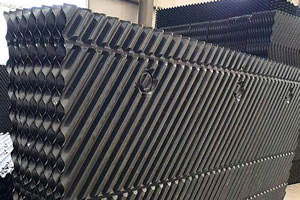
Fill selection should also consider the tower's existing geometry and the supplier's technical recommendations. A configuration suitable for a relatively clean indirect cooling circuit may not be appropriate for a system exposed to heavier contamination.
For steel manufacturing facilities, the most suitable cooling tower fill arrangement is not determined by the industry name alone. It depends on the specific cooling circuit, heat load, water quality, tower configuration, and maintenance capabilities. By understanding these conditions before making engineering decisions, plant operators and project engineers can develop more reliable cooling tower applications that support stable steel production.