

Understanding crossflow vs counterflow cooling tower fill is important when selecting replacement media or sourcing fill for a new cooling tower. The main difference between these two arrangements is the direction of airflow in relation to falling water. This difference affects the tower layout, water distribution system, fill configuration and replacement requirements. Although both designs use fill media to support heat and mass transfer, their products should not be selected based on appearance alone.
1. What Is Crossflow Cooling Tower Fill?
In a crossflow cooling tower, water flows downward through the fill while air moves horizontally across it. The two flow directions are approximately perpendicular.
Many crossflow towers use a gravity-fed hot-water distribution basin positioned above the fill. Water passes through openings in the basin and spreads over the fill sheets or other media. The airflow enters through the tower sides and passes horizontally through the fill section.
Crossflow cooling tower fill is commonly supplied in assembled packs or individual sheets, depending on the product design and project requirements. When selecting replacement products, buyers should check the pack orientation, fill depth, overall dimensions, sheet arrangement and support structure.
2. What Is Counterflow Cooling Tower Fill?
In a counterflow cooling tower, water moves downward through the fill while air travels upward in the opposite direction. Both streams pass through the fill section in opposing directions.
Counterflow towers commonly use pressurized water distribution systems with spray pipes and nozzles above the fill. The water is distributed over the media while air enters through lower sections of the tower and moves upward.
Counterflow cooling tower fill must be compatible with the tower's internal arrangement. Buyers should confirm the fill pack dimensions, installation orientation, sheet geometry, support conditions and clearance around the water distribution components.
3. Key Differences Buyers Should Understand
The following points help distinguish the two configurations:
- Airflow direction: Crossflow uses horizontal airflow through the fill, while counterflow uses upward airflow against falling water.
- Water distribution: Crossflow towers commonly use gravity-fed distribution basins, whereas counterflow towers commonly use pressurized spray systems.
- Internal layout: The location of air inlets, distribution components, fill supports and access areas can differ significantly.
- Replacement requirements: Fill dimensions, block orientation, water distribution arrangements and support structures must match the existing tower.
These are typical design characteristics rather than universal rules. Actual arrangements should always be confirmed against the tower drawings or existing equipment.
4. How to Select the Correct Fill for Replacement
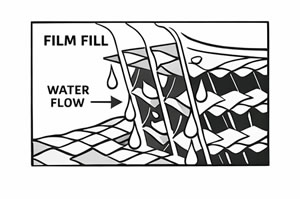
Before ordering, identify whether the existing tower is crossflow or counterflow. Then determine whether it uses film fill or splash fill. These are separate classifications: film and splash describe the fill structure, while crossflow and counterflow describe the airflow and water-flow arrangement. Both film fill and splash fill can be used in either tower configuration when properly designed.
Next, collect the existing fill length, width and height, sheet thickness, flute spacing, pack dimensions and required quantity. Also check the installation space, support arrangement, water distribution system and airflow direction.
Photos, drawings and samples can help clarify details that are difficult to measure. A tower model or brand name may provide useful background, but it should not replace verification of the actual product dimensions and configuration.
5. Information to Include in Your Inquiry
When requesting a quotation, provide the tower configuration, fill type, material preference, dimensions, quantity and available reference photos or drawings. Operating temperature and water-quality information may also be relevant when evaluating material suitability.
TowerFill.com supplies crossflow and counterflow cooling tower fill products for international B2B buyers. Customers can submit project information for product review and quotation under EXW or FOB trade terms. Confirm the proposed fill specifications and compatibility before placing a replacement order.