

Cooling Tower Fill Thickness Explained: How It Affects Performance and Service Life
Cooling tower fill thickness is one of the most overlooked factors when selecting replacement fill or designing a new cooling system. While many buyers focus on material type or fill spacing, sheet thickness directly influences mechanical strength, cooling performance, service life, and long-term operating costs.
This guide explains how cooling tower fill thickness affects performance and how to choose the right specification for different industrial applications.

What Is Cooling Tower Fill Thickness?
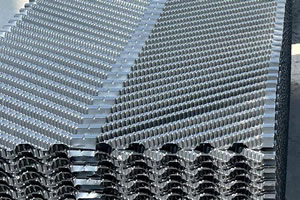
Cooling tower fill thickness refers to the thickness of each PVC or PP sheet used to manufacture the fill pack. It is commonly measured in millimeters (mm) and varies according to the application, operating environment, and structural requirements.
Typical Thickness Range
- 0.30 mm – Lightweight applications
- 0.35 mm – Standard industrial cooling towers
- 0.40 mm – Heavy-duty industrial systems
- 0.45 mm and above – High-load or customized applications
Why Fill Thickness Matters
The thickness of cooling tower fill influences more than just product strength. It also affects airflow resistance, installation stability, deformation resistance, and overall operating life.
Main Benefits of Proper Thickness Selection
- Improves structural stability
- Extends service life
- Reduces deformation under load
- Improves resistance to cleaning and maintenance
- Supports long-term cooling performance
How Thickness Affects Cooling Tower Fill Performance
Mechanical Strength
Thicker sheets provide greater rigidity and reduce the risk of deformation during transportation, installation, and long-term operation.
Heat Transfer Performance
Sheet thickness itself has only a minor influence on heat transfer. The overall cooling efficiency depends more on fill geometry, surface area, and water distribution.
Airflow Resistance
When designed correctly, increasing sheet thickness has little impact on airflow. However, poor manufacturing quality may reduce the effective flow area.
Choosing the Right Thickness
| Application | Recommended Thickness | Reason |
|---|---|---|
| Commercial HVAC | 0.30–0.35 mm | Lightweight and efficient |
| Industrial Cooling | 0.35 mm | Balanced performance and durability |
| Chemical Plants | 0.40 mm | Higher structural strength |
| Heavy-Duty Operations | 0.40–0.45 mm | Improved resistance to deformation |
Factors That Influence Thickness Selection
Operating Temperature
Higher temperatures may require PP fill or thicker PVC sheets depending on system conditions.
Systems with heavy scaling or frequent cleaning often benefit from stronger fill sheets that better withstand maintenance.
Cooling Tower Size
Larger cooling towers typically place greater mechanical stress on fill packs, making structural strength more important.
Common Misconceptions
- Thicker fill always provides better cooling.
- The thinnest fill is always the most efficient.
- Thickness is more important than fill geometry.
- All manufacturers use the same sheet thickness.
In reality, cooling performance depends on the balance between geometry, material quality, thickness, and manufacturing precision.
Quality Control During Manufacturing
Thickness Consistency
Professional manufacturers use precision forming equipment to ensure uniform sheet thickness throughout production.
Material Quality
Virgin PVC or high-quality PP materials help maintain consistent thickness, strength, and long-term durability.
Dimensional Inspection
Each production batch should be inspected for thickness tolerance, bonding quality, and structural integrity before shipment.
Frequently Asked Questions
Does thicker cooling tower fill improve cooling efficiency?
Not necessarily. Cooling efficiency depends mainly on fill geometry and heat transfer surface area rather than sheet thickness alone.
What thickness is commonly used for industrial cooling towers?
Many industrial systems use 0.35 mm PVC fill because it offers an excellent balance between cooling performance and mechanical strength.
Can thin fill reduce service life?
If the sheet is too thin for the application, it may deform or become damaged more easily, reducing its operational lifespan.
Conclusion
Selecting the appropriate cooling tower fill thickness helps improve structural reliability, reduce maintenance, and maximize long-term operating performance. The ideal thickness should always be determined by operating conditions, water quality, tower design, and expected service life rather than price alone.
TowerFill manufactures premium PVC film fill, PP fill, splash fill, and customized cooling tower fill solutions in multiple sheet thicknesses to meet different industrial cooling requirements. Contact our engineering team for professional recommendations tailored to your project.