

How Cooling Tower Fill Geometry Affects Heat Transfer and Cooling Efficiency
Cooling tower fill is the core component responsible for maximizing heat exchange between circulating water and ambient air. While many engineers focus on fill material or tower size, fill geometry is equally important because it directly determines water distribution, airflow resistance, heat transfer efficiency, and long-term operating performance.
This article explains how cooling tower fill geometry influences thermal performance and how engineers can select the most suitable fill design for different industrial applications.
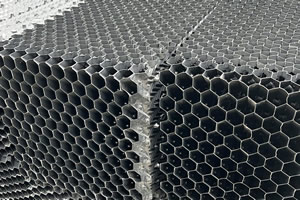
What Is Cooling Tower Fill Geometry?
Cooling tower fill geometry refers to the structural design of fill sheets, including flute angle, corrugation depth, sheet spacing, surface texture, and block configuration. These design elements work together to maximize the contact area between water and air.
Main Components of Fill Geometry
- Corrugation angle
- Sheet spacing
- Surface embossing
- Flow channel design
- Fill pack height
- Block dimensions
Each parameter affects airflow, water distribution, pressure drop, and cooling efficiency.
Why Fill Geometry Matters
The primary function of cooling tower fill is to create a large wetted surface where water can spread into thin films while air passes through the fill pack. Better geometry creates a larger heat transfer area without significantly increasing airflow resistance.
Benefits of Optimized Fill Geometry
- Higher heat transfer efficiency
- More uniform water distribution
- Reduced dry spots
- Lower pressure drop
- Improved cooling performance
- Longer service life
Key Design Factors
1. Corrugation Angle
The corrugation angle determines how water changes direction while flowing through the fill. Proper angles improve turbulence and increase the contact time between water and air.
Advantages
- Improves heat exchange
- Reduces channeling
- Enhances water film formation
2. Sheet Spacing
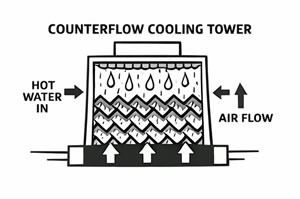
Sheet spacing controls the airflow passage inside the fill pack.
| Sheet Spacing | Characteristics | Typical Application |
|---|---|---|
| Small | Higher efficiency, easier fouling | Clean water systems |
| Medium | Balanced performance | General industrial cooling |
| Large | Lower clogging risk | Dirty water applications |
3. Surface Texture
Embossed surfaces help distribute water into thin films, increasing the effective heat transfer area while maintaining stable flow.
4. Fill Pack Height
Increasing fill height generally increases cooling capacity, but excessive height also increases pressure drop and fan energy consumption. Proper engineering balance is essential.
How Fill Geometry Influences Cooling Efficiency
Water Distribution
Well-designed geometry spreads water evenly across the entire fill pack, reducing bypass flow and improving cooling consistency.
Airflow Distribution
Uniform airflow minimizes dead zones and allows maximum contact between air and water.
Heat Transfer Surface Area
Optimized geometry significantly increases the available wetted surface, allowing more efficient evaporation and sensible heat transfer.
Choosing the Right Fill Geometry
The optimal fill geometry depends on operating conditions rather than a single universal design.
| Operating Condition | Recommended Fill Geometry |
|---|---|
| Clean Water | High-efficiency film fill with narrow spacing |
| Industrial Water | Medium spacing film fill |
| High Fouling Water | Splash fill or wide-spacing fill |
| High Temperature | PP fill with optimized airflow channels |
Common Design Mistakes
- Selecting fill based only on price
- Ignoring water quality
- Using high-efficiency fill in dirty water systems
- Choosing incorrect sheet spacing
- Overlooking airflow resistance
Maintenance Considerations
Even the best fill geometry requires regular inspection and cleaning. Dirt, biological growth, and scale can block airflow channels and reduce cooling efficiency.
Routine maintenance helps preserve the designed thermal performance throughout the service life of the fill.
Frequently Asked Questions
Does more surface area always improve cooling?
No. More surface area generally improves heat transfer, but excessive density can increase pressure drop and clogging, reducing overall efficiency.
Which fill geometry is best for dirty water?
Wide-spacing film fill or splash fill is generally recommended because it provides better resistance to fouling and blockage.
Can fill geometry reduce energy consumption?
Yes. Optimized geometry improves heat transfer while reducing unnecessary airflow resistance, helping lower fan energy consumption.
Conclusion
Cooling tower fill geometry is one of the most important factors affecting cooling efficiency, airflow distribution, and long-term reliability. Selecting the appropriate corrugation angle, sheet spacing, surface texture, and fill height can significantly improve thermal performance while reducing maintenance requirements.
As a professional cooling tower fill manufacturer, TowerFill provides customized PVC fill, PP fill, splash fill, drift eliminators, and engineered fill solutions for industrial cooling applications worldwide. Contact our engineering team for assistance in selecting the most suitable cooling tower fill for your project.