

How Water Quality Affects Cooling Tower Fill Performance
Water quality has a direct impact on the efficiency, reliability, and service life of Cooling Tower Fill. Even the highest-quality fill media cannot perform efficiently if circulating water contains excessive minerals, biological contaminants, or suspended solids. Poor water quality reduces heat transfer, restricts airflow, and increases maintenance costs.
An effective water treatment program helps preserve cooling tower efficiency while protecting fill media from premature deterioration. Understanding how different water quality issues affect cooling tower operation allows facility managers to minimize downtime and maximize equipment lifespan.
This article explains the relationship between water quality and cooling tower fill performance, along with practical maintenance recommendations.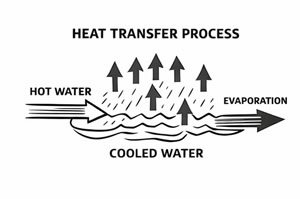
1. Mineral Scaling Reduces Heat Transfer
Hard water contains dissolved minerals such as calcium and magnesium. As water evaporates inside the cooling tower, these minerals accumulate on the surface of the fill media, creating scale that acts as an insulating layer.
Even a thin layer of scale can significantly reduce heat transfer efficiency, forcing fans and pumps to work harder while increasing operating costs.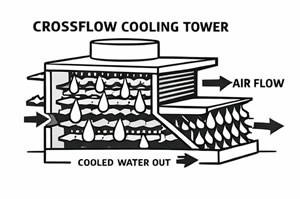
2. Biological Fouling Restricts Airflow
Warm, wet environments are ideal for algae, bacteria, and biofilm growth. These contaminants block airflow passages within the fill pack, reduce water distribution efficiency, and increase system pressure loss.
Routine cleaning and proper biocide treatment help protect both Counterflow Film Fill and Crossflow Film Fill from biological fouling.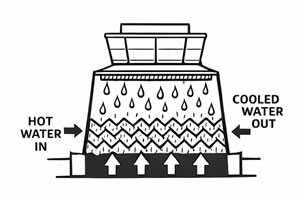
3. Suspended Solids Can Clog Fill Media
Cooling systems that use river water, recycled water, or process water often contain suspended solids. Dirt, sand, fibers, and debris can accumulate inside traditional film fill, reducing airflow and limiting cooling efficiency.
For these demanding applications, Splash Grid Fill is often the preferred solution because its open structure is more resistant to clogging and easier to clean.
4. Chemical Balance Protects Fill Materials
Improper chemical treatment can damage cooling tower components over time. Maintaining appropriate pH levels, corrosion inhibitors, and disinfectant concentrations helps preserve the integrity of both PVC Cooling Tower Fill Media and PP Cooling Tower Fill, ensuring long-term performance.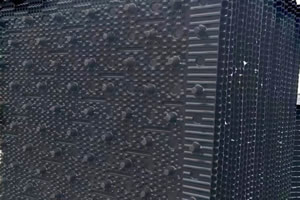
5. Temperature and Water Chemistry Influence Fill Selection
Water quality is closely related to operating temperature. High-temperature systems accelerate mineral deposition and may expose fill materials to harsher chemical conditions. Selecting the proper fill material helps improve durability under different operating environments.
For standard HVAC and commercial cooling towers, PVC Cooling Tower Fill Media offers excellent heat transfer and cost efficiency. In high-temperature or chemically aggressive applications, PP Cooling Tower Fill provides greater resistance to thermal deformation and chemical attack.
Best Practices for Maintaining Water Quality
Maintaining proper water quality requires a combination of monitoring, treatment, and routine maintenance. The following practices help maximize cooling tower fill performance:
- Regularly monitor pH, conductivity, and hardness.
- Maintain an effective water treatment program.
- Control biological growth using approved biocides.
- Remove suspended solids through filtration or basin cleaning.
- Inspect fill media routinely for scaling and fouling.
- Replace damaged fill before cooling performance declines.
Frequently Asked Questions
Why does hard water reduce cooling tower efficiency?
Hard water leaves mineral deposits on the fill surface as water evaporates. These deposits reduce heat transfer efficiency and restrict airflow through the fill pack.
Which fill is better for poor water quality?
For systems containing high levels of suspended solids, Splash Grid Fill is generally recommended because its open structure is less susceptible to clogging than traditional film fill.
Can water treatment extend cooling tower fill life?
Yes. Proper water treatment minimizes scaling, corrosion, and biological fouling, helping cooling tower fill maintain its thermal performance and extending its service life.
Should water quality be tested regularly?
Absolutely. Routine testing helps identify changes in water chemistry before they damage fill media or reduce cooling tower efficiency.
Conclusion
Water quality plays a critical role in determining the efficiency and longevity of cooling tower fill. By controlling mineral scaling, biological fouling, suspended solids, and chemical balance, facility managers can maintain high heat transfer performance while reducing maintenance costs and extending equipment life.
Whether your cooling tower uses Counterflow Film Fill, Crossflow Film Fill, Splash Grid Fill, PVC Cooling Tower Fill Media, or PP Cooling Tower Fill, maintaining excellent water quality is essential for achieving maximum cooling efficiency.
Optimize Cooling Tower Performance with the Right Fill
We manufacture high-performance cooling tower fill solutions for HVAC systems, industrial processing, power plants, and water treatment facilities. Our engineering team can recommend the most suitable fill media based on your water quality, operating temperature, and tower configuration.
- Counterflow Film Fill
- Crossflow Film Fill
- Splash Grid Fill
- PVC Cooling Tower Fill Media
- PP Cooling Tower Fill
- Drift Eliminators
- Cooling Tower Air Inlet Louvers
For technical consultation or a customized quotation, please contact our engineering team.