

How to Inspect Existing Cooling Tower Fill Before Replacement
Cooling tower fill plays a critical role in maintaining heat exchange efficiency. However, fill materials gradually deteriorate due to continuous exposure to water, heat, chemicals, biological growth, and environmental contaminants. Replacing fill too early increases operating costs, while replacing it too late can significantly reduce cooling performance and increase energy consumption.
Before investing in new cooling tower fill, engineers should perform a comprehensive inspection to determine whether cleaning, repair, or complete replacement is the most appropriate solution. This guide explains the inspection process used to evaluate cooling tower fill condition and helps maintenance teams make informed decisions.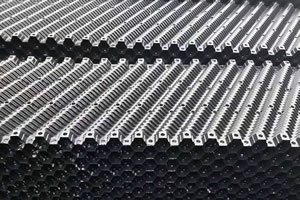
Why Cooling Tower Fill Inspection Is Important
Many cooling tower performance problems originate from aging or damaged fill rather than mechanical equipment failure. A systematic inspection allows maintenance personnel to identify performance issues before they become costly shutdowns.
- Improve cooling efficiency
- Reduce unexpected downtime
- Extend equipment service life
- Lower maintenance costs
- Optimize replacement planning
When Should Cooling Tower Fill Be Inspected?
Routine Preventive Maintenance
Industrial cooling towers should undergo visual inspection at least once or twice per year depending on operating conditions.
After Cooling Performance Declines
If outlet water temperature increases or approach temperature becomes unstable, fill condition should be evaluated immediately.
Before Major Shutdown Maintenance
Scheduled plant shutdowns provide an ideal opportunity to inspect fill modules, support structures, and water distribution systems.
Visual Inspection Checklist
Check for Scaling
Mineral deposits reduce the effective heat transfer area and restrict water flow through the fill channels.
Inspect Biological Fouling
Algae, bacteria, and slime decrease airflow while increasing maintenance requirements.
Look for Broken Fill Sheets
Cracked or damaged sheets reduce structural integrity and cooling efficiency.
Check for Deformation
High temperatures or long-term loading may warp fill packs and restrict airflow.
Inspect for Collapsed Sections
Collapsed fill blocks water distribution and creates uneven airflow inside the tower.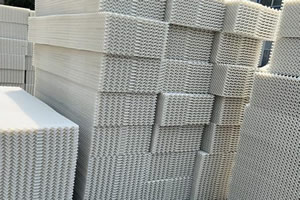
Performance Inspection
Approach Temperature
A rising approach temperature often indicates declining heat transfer performance.
Pressure Drop
Excessive pressure drop usually indicates blockage caused by scale or biological growth.
Water Distribution
Uneven water distribution creates dry areas and reduces effective cooling surface.
Airflow
Restricted airflow can significantly decrease cooling tower capacity even if the fill appears visually acceptable.
Inspection Checklist
| Inspection Item | Normal Condition | Warning Sign | Replacement Recommended |
|---|---|---|---|
| Scale Build-up | Light | Moderate | Heavy Deposits |
| Biological Growth | Minimal | Visible Slime | Severe Fouling |
| Fill Shape | Flat | Slight Deformation | Collapsed |
| Water Distribution | Uniform | Uneven | Blocked Areas |
| Air Passage | Clear | Partially Restricted | Severely Blocked |
How Water Quality Affects Fill Condition
Water chemistry has a direct impact on fill life. High hardness accelerates scaling, while suspended solids increase blockage. Systems with biological contamination require more frequent inspection than clean-water cooling towers.
Common Water Problems
- High calcium hardness
- Silica scaling
- Suspended solids
- Algae growth
- Oil contamination
When Cleaning Is Enough
If the fill structure remains intact and only light deposits are present, professional cleaning may restore thermal performance without requiring replacement.
Suitable Conditions for Cleaning
- No structural damage
- Minor scale accumulation
- Limited biological growth
- Stable support structure
When Replacement Is Necessary
Replacement should be considered when cleaning can no longer restore cooling performance or when the fill has suffered irreversible structural damage.
Typical Replacement Indicators
- Broken fill sheets
- Severe deformation
- Collapsed fill packs
- Permanent blockage
- Repeated cooling efficiency loss
Cooling Tower Fill Inspection Checklist
- ✓ Inspect fill surface condition
- ✓ Check scaling and fouling
- ✓ Measure approach temperature
- ✓ Verify water distribution
- ✓ Observe airflow condition
- ✓ Inspect support beams
- ✓ Record damaged areas
- ✓ Decide between cleaning and replacement
Conclusion
Regular inspection is the most effective way to maximize the service life of cooling tower fill while maintaining stable thermal performance. By evaluating structural condition, airflow, water distribution, and water quality, maintenance teams can determine whether cleaning or replacement is the most cost-effective solution. A well-planned inspection program not only reduces maintenance expenses but also helps ensure reliable cooling tower operation throughout the equipment lifecycle.