

Counterflow vs Crossflow Film Fill: Which Cooling Tower Fill Design Performs Better?
When selecting the right Cooling Tower Fill, engineers often focus on material selection, such as PVC or PP. However, the fill design is just as important. The two most common film fill configurations are Counterflow Film Fill and Crossflow Film Fill. Each is designed for a different cooling tower configuration and offers unique advantages.
Choosing the correct fill type can improve heat transfer efficiency, reduce pressure loss, simplify maintenance, and extend the service life of the cooling tower. Selecting the wrong design, on the other hand, may reduce overall cooling performance even when high-quality fill material is used.
This article explains the differences between counterflow and crossflow film fill, compares their performance, and provides practical guidance to help you select the most suitable solution for your cooling tower project.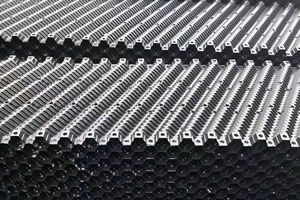
What Is Film Fill?
Film fill is a type of cooling tower packing designed to maximize the contact area between circulating water and airflow. Water forms a thin film over the surface of the fill sheets, allowing heat to be removed efficiently through evaporation.
Compared with splash-type fill, film fill generally provides higher heat transfer efficiency and is widely used in commercial HVAC systems, power plants, and industrial cooling towers with relatively clean circulating water.
Modern film fill is available in different configurations to match various cooling tower designs. The most common options are Counterflow Film Fill and Crossflow Film Fill.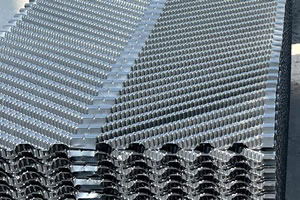
How Does Counterflow Film Fill Work?
In a counterflow cooling tower, air moves upward while water flows downward through the fill. Because the two streams travel in opposite directions, the temperature difference remains relatively high throughout the heat exchange process, resulting in excellent cooling efficiency.
Counterflow Film Fill is specifically engineered to provide uniform water distribution while maintaining sufficient airflow. The corrugated sheet design creates a large heat transfer surface without causing excessive pressure drop.
Typical applications include:
- Power plants
- Industrial manufacturing facilities
- Petrochemical plants
- HVAC systems requiring high cooling efficiency
- Cooling tower retrofit projects
For facilities where thermal performance is the highest priority, counterflow designs are often the preferred choice.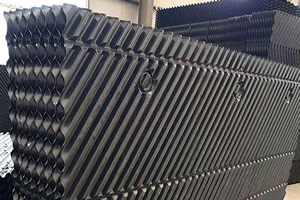
How Does Crossflow Film Fill Work?
A crossflow cooling tower operates differently. Water flows vertically through the fill while air enters horizontally from the sides of the tower. This configuration simplifies water distribution and often makes maintenance easier because the hot water basin is located above the fill.
Crossflow Film Fill is designed to maintain even water coverage while minimizing airflow resistance. It is widely used in commercial buildings, district cooling systems, and facilities where convenient maintenance access is important.
Typical applications include:
- Commercial buildings
- Shopping centers
- Hospitals
- Office complexes
- District cooling systems
Although crossflow and counterflow towers achieve the same objective, the internal airflow pattern requires different fill geometries for optimal performance.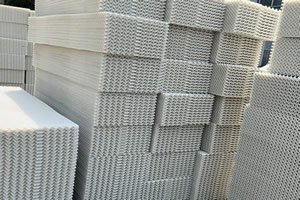
Counterflow vs Crossflow Film Fill: Side-by-Side Comparison
Although both fill types are designed to improve cooling efficiency, their structures are optimized for different cooling tower configurations. Choosing the correct fill design ensures stable performance, lower maintenance costs, and longer equipment life.
| Comparison | Counterflow Film Fill | Crossflow Film Fill |
|---|---|---|
| Airflow Direction | Upward | Horizontal |
| Water Flow Direction | Downward | Downward |
| Cooling Efficiency | Very High | High |
| Water Distribution | Spray Nozzles | Gravity Basin |
| Maintenance Access | Moderate | Excellent |
| Typical Application | Industrial Cooling | Commercial HVAC |
Neither design is universally better. The correct choice depends on the cooling tower's original design and operating conditions. Replacing fill with an incompatible configuration may reduce thermal performance and increase operating costs.
How Water Quality Influences Film Fill Performance
Water quality is one of the most important factors affecting the service life of any Cooling Tower Fill. Film fill provides excellent heat transfer, but its narrow flow channels require relatively clean circulating water to maintain peak performance.
Where scaling, suspended solids, or biological growth are not properly controlled, deposits can gradually restrict water flow and reduce cooling efficiency. Regular inspection and water treatment are therefore essential regardless of whether you use Counterflow Film Fill or Crossflow Film Fill.
For applications with consistently dirty water, engineers may also evaluate Splash Grid Fill, which is generally more resistant to fouling than film fill designs.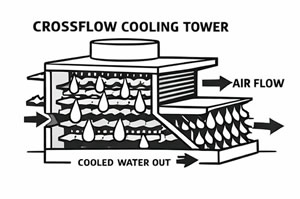
Installation and Maintenance Recommendations
Proper installation is just as important as selecting the correct fill. Even premium-quality fill media cannot achieve its designed performance if it is installed incorrectly or if other tower components are in poor condition.
During every shutdown, technicians should inspect the following components together with the fill:
- Drift Eliminators
- Cooling Tower Air Inlet Louvers
- Spray nozzles and water distribution system
- Fill support structure
- Cold water basin
- Fan and mechanical drive system
A complete inspection minimizes unexpected downtime and ensures the new fill operates at maximum efficiency throughout its service life.