

Counterflow vs Crossflow Cooling Tower Fill: Which Is Better?
Selecting the right Cooling Tower Fill is one of the most important decisions when designing a new cooling tower or replacing aging fill media. Two of the most common options are counterflow film fill and crossflow film fill. Although both are designed to maximize heat transfer between water and air, they differ in airflow direction, water distribution, maintenance requirements, and suitable applications.
Understanding these differences helps engineers, contractors, and facility managers choose the best fill configuration for long-term cooling performance and operating efficiency.
This article compares counterflow and crossflow cooling tower fill, highlighting their advantages, limitations, and recommended applications.
How Counterflow Cooling Towers Work
In a counterflow cooling tower, air moves vertically upward while hot water flows downward through the fill media. Because the air and water travel in opposite directions, heat exchange is highly efficient and the cooling tower can achieve excellent thermal performance within a relatively compact footprint.
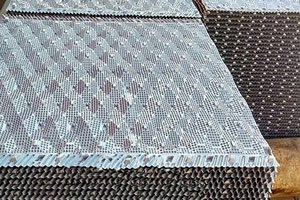
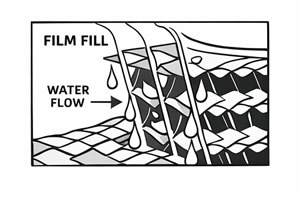
Counterflow Film Fill is specifically engineered for this tower design. Its corrugated structure creates a large heat transfer surface while maintaining efficient airflow through the fill pack.
Main advantages include:
- High heat transfer efficiency
- Compact tower design
- Excellent cooling performance
- Suitable for industrial process cooling
- Reduced footprint for limited installation space
How Crossflow Cooling Towers Work
Crossflow cooling towers allow air to enter horizontally through the sides of the tower while water flows vertically downward through the fill. Because gravity assists water distribution, these systems often require lower pump pressure and offer easier maintenance access.
Crossflow Film Fill is designed to provide uniform water distribution while maintaining efficient airflow across the fill surface.
Key advantages include:
- Simple water distribution system
- Easy maintenance access
- Stable operating performance
- Lower water distribution pressure requirements
- Widely used in commercial HVAC systems
Performance Comparison
| Feature | Counterflow Fill | Crossflow Fill |
|---|---|---|
| Airflow Direction | Vertical Upward | Horizontal |
| Heat Transfer Efficiency | Excellent | Very Good |
| Tower Size | More Compact | Larger Footprint |
| Maintenance Access | Moderate | Easier |
| Typical Applications | Industrial Cooling | Commercial HVAC |
Which Fill Is Right for Your Cooling Tower?
If maximum cooling efficiency and compact tower dimensions are your priorities, Counterflow Film Fill is typically the preferred option. It performs especially well in manufacturing facilities, power plants, and industrial process cooling systems where thermal performance is critical.
If ease of maintenance, simplified water distribution, and reliable long-term operation are more important, Crossflow Film Fill is often the better choice. It is commonly installed in commercial buildings, HVAC systems, and institutional cooling towers.
For applications involving dirty water or heavy suspended solids, either design may benefit from replacing film media with Splash Grid Fill, which offers greater resistance to clogging.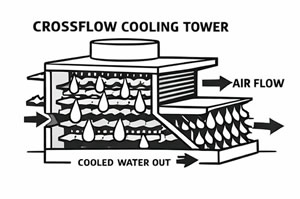
Maintenance Considerations
Both counterflow and crossflow cooling tower fill require routine inspection to maintain high thermal efficiency. Regardless of the tower design, mineral scaling, biological fouling, and debris accumulation can reduce airflow and restrict water distribution if left untreated.
- Inspect fill packs every month.
- Maintain proper water treatment to minimize scale and algae.
- Clean deposits before airflow becomes restricted.
- Replace damaged fill sections promptly.
- Inspect Drift Eliminators and Cooling Tower Air Inlet Louvers during scheduled maintenance.
Whether using Counterflow Film Fill or Crossflow Film Fill, consistent preventive maintenance ensures stable cooling performance and extends the service life of the entire cooling tower.
Frequently Asked Questions
Which cooling tower fill provides better heat transfer?
Counterflow film fill generally delivers higher heat transfer efficiency because air and water move in opposite directions, maximizing contact time between the two.
Is crossflow cooling tower fill easier to maintain?
Yes. Crossflow cooling towers usually provide easier access to the fill and water distribution system, making routine inspections and maintenance more convenient.
Can I replace counterflow fill with crossflow fill?
No. Fill media must match the original cooling tower design. Counterflow and crossflow towers use different airflow and water distribution arrangements, so the fill types are not interchangeable.
What if my cooling tower handles dirty water?
For applications containing large amounts of suspended solids or debris, Splash Grid Fill is often the better option because its open structure is less likely to clog than traditional film fill.
Conclusion
Both counterflow and crossflow cooling tower fill provide reliable heat transfer when selected for the appropriate tower design. Counterflow Film Fill offers maximum thermal efficiency and compact installation, while Crossflow Film Fill provides easier maintenance and simplified water distribution.
Choosing the correct fill type, maintaining proper water treatment, and performing regular inspections will maximize cooling efficiency, reduce operating costs, and extend equipment lifespan.
Find the Right Cooling Tower Fill Solution
We manufacture a complete range of cooling tower fill products for commercial and industrial applications. Whether your system requires counterflow, crossflow, splash fill, or specialized high-temperature solutions, our engineering team can recommend the most suitable option.
- Counterflow Film Fill
- Crossflow Film Fill
- Splash Grid Fill
- PVC Cooling Tower Fill Media
- PP Cooling Tower Fill
- Drift Eliminators
- Cooling Tower Air Inlet Louvers
For technical support or a customized quotation, please contact our engineering team.